Showing posts with label artificial nose. Show all posts

Thursday, March 3, 2022

Organoids of the Nasal Persuasion


Model of the human nose reveals first steps of SARS-CoV-2 and RSV infection
Feb 2022, phys.org

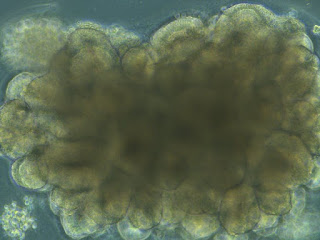
I used to think it was a big deal that we knew how to grow diamonds in a laboratory. But then we started to grow organs. Intestines, kidneys, lungs,  brains (pictured above) and now noses.

They made a nose from scratch, using nose epithelial cells swabbed from somebody's nose, and placed on a substrate designed to enable them to interact as they normally would with the environment. (For this study, they were adding to that environment SARS-CoV-2 and RSV virions.) We could then call this an artificial nose, although that might be misleading. It's not full-blown olfaction, but it's a step. 

via Baylor College of Medicine: Anubama Rajan et al, The Human Nose Organoid Respiratory Virus Model: an Ex Vivo Human Challenge Model To Study Respiratory Syncytial Virus (RSV) and Severe Acute Respiratory Syndrome Coronavirus 2 (SARS-CoV-2) Pathogenesis and Evaluate Therapeutics, mBio (2022). DOI: 10.1128/mbio.03511-21

Image credit: This is a human brain organoid, from the National Institutes of Health, circa 2021.

Thursday, August 31, 2017

Olfaction Meets AI


Headline reads like this:

Aug 2017, BBC

And inside:

Nigerian Oshi Agabi’s modem-sized device - dubbed Koniku Kore - could provide the brain for future robots. It is an amalgam of living neurons and silicon, with olfactory capabilities — basically sensors that can detect and recognise smells.

And an explanation:

While computers are better than humans at complex mathematical equations, there are many cognitive functions where the brain is much better: training a computer to recognise smells would require colossal amounts of computational power and energy, for example.

The prototype device shown off at TED - the pictures of which cannot yet be publicly revealed - has partially solved one of the biggest challenges of harnessing biological systems - keeping the neurons alive. "This device can live on a desk and we can keep them alive for a couple of months," Agabi told the BBC.

And what do we think about this?

As much as this story is pretty nuts (if the sentence “They can live on a desk” doesn’t make your head spin…), it’s all too common a story in the tech world. Not that it’s fake news or anything, but let’s just say it is misleading to talk about “smelling robots” in this way.

The less interesting truth is that they can only be trained to smell specific molecules, not even signatures, or combinations, of molecules. A system able to smell “anything that might come up,” and able to use that information for something important, such a system could not be trained. Well, hmmm,  we get trained to do this from birth, in fact we are already learning about our olfactory environment in utero.

So if we want AI to meet olfaction, what we need to do is keep them alive for a lifetime, and give them a body, and friends and a job. You know, just like a real person. They would need to learn from the ground up, just like a real person.

However ---

There is a point being made here by Mr. Agabi that is totally in-line with the thesis of Hidden Scents. The way we use computers today will eventually be supplanted by something else. Traditional computation will still be useful, but something else will take us beyond the capacities of today’s technology (whole lotta talk in the sci-fi sphere of quantum computing, for example).

As of now, neural networks are taking us in a new direction. Granted they were used back in the 80’s, but only recently have they become a marked change in computing technique. (I like to note here the contemporaneous link between the architecture of neural networks and how it is the same thing used to mine bitcoins – the processor is no longer the key component, it’s how many graphics cards you have all wired together.)

The olfactory bulb, the crux of the olfactory system, from an information processing point of view, is a model neural network. And the fact that it’s already connected to the limbic system – the thing that makes us move, the thing that makes our bodies work, and even our emotions – this makes it a model system for so much more.


*Anyone with more comp sci knowledge than me please feel free to correct as I am no expert and speaking in pretty broad, possibly misunderstood, terms.  

Saturday, July 1, 2017

Synthetic Tongue


Snakes, and many reptiles, have a split tongue because they smell with their tongue, and the two-tongues let them know which direction the smell is coming from. Humans, however, have split tongues because they want to. Tongue-splitting is a form of body modification.

In other news:

Jun 2017, phys.org

“These synthetic "tongues" can highlight similarities between whiskies, but they can't identify an unknown whisky from scratch, he says, "You start with a sample that you know is the real McCoy. Then you look at another sample, and you can say whether it's the same sample or it's not." In other words, these tongues would be great for spotting counterfeits of expensive luxury whiskies.”

Note that this synthetic tongue cannot taste like we do. Well, first of all, note that taste and smell are very similar; Humans don’t smell with our tongues like snakes do, but most of what we “taste” is actually perceived by our nose. Nonetheless, this synthetic whisky tongue still does not work the same way as our perceptive apparatus. This tongue can only identify pre-determined patterns. You give it one flavor profile to ‘sense,’ and ask whether a new sample matches that or not. You can’t give it any old thing and ask “what is this?”

Perhaps the most amazing thing about our olfactory sensory apparatus is that it begins as a blank slate, with no hardwiring for any smells whatsoever. Everything we smell, and everything we can identify, we learn. If we want this synthetic whisky tongue to be able to identify a whisky from scratch, we need it to grow up like a little human, learning every single smell from scratch, just like us.

This is the same old story with all of these reverse-engineered smell-and-taste organs. They cannot be used to sense the way we do, where they are able to identify any combination of hundreds of thousands chemicals. Instead, they are given one job, to smell one thing, and they either smell it or they don’t. It’s like making an eye that is only for seeing the color red. Red or no red. It doesn’t know the Pantone catalog, only that one red.  Instead of choosing from the infinite answers to the question “what do you smell,” these prostheses can only choose from two possible answers, yes and no.

To program a truly synthetic tongue, or better, a synthetic nose, is still very, very far beyond our capacity. In the meantime, things will progress as they do; one piece at a time, dividing the human capacity for information-gathering into myriad discrete operations, and recreating ourselves through the fractured image of technology.

Image source: link


Tuesday, January 3, 2017

Open Up

Image source

can someone figure out how to turn this into an artificial nose pleaes

WIRED, Jan 2016

Wednesday, October 19, 2016

The Ever Impending Electronic Nose


CMOS Sensor, image source

The electronic nose has been coming forever. We already have artificial noses in the form of mass spectrometers. The new kind use integrated circuits, the same CMOS chips that are in cellphones. They aren’t tied to a thinking, feeling human, but at least the initial step of identification is happening.

This article in particular is touting the use of an artificial nose to analyze breath samples, citing that “breaths contain gases from the stomach and that come out of blood when it comes into contact with air in the lungs. The breath test is a blood test without taking blood samples. Breath contains information about practically every part of a human body.”

This is good stuff, and explains why your breath starts to smell funny when you’re hungry, or why diabetic-breath smells like acetone, but I must keep going and repeat the sales pitch of this scientist:

"If you think about the industry around sensors that emulate our senses, it's huge," said Dr. O, also a professor in the Erik Jonsson School of Engineering and Computer Science and holder of the Texas Instruments Distinguished University Chair. "Imaging applications, hearing devices, touch sensors—what we are talking about here is developing a device that imitates another one of our sensing modalities and making it affordable and widely available. The possible use of the electronic nose is almost limitless. Think about how we use smell in our daily lives."

But yes, let’s think for a minute about how we use smell in our daily lives. Smell is so below the radar that we don’t consciously register most of its ongoings. So when we take this CMOS sensor to a brain, what exactly would we like it to do? Of course we can’t engineer the olfactory bulb itself, or the subsequent limbic system (in concert with our memory) that ultimately creates our experience of smell. But if we were to isolate it, and use it for specific things, like breath analysis, then what else would it do?

Gas leaks, obviously. Maybe it could alert my roommate to change the litter box? Or tell a parent that their teenager was drinking last night (that’s a simple breathalyzer built into the air system of the house; watch out kids). You would think we’d already have one to smell the maple syrup smell coming from the burning transmission fluid in your engine. And what else? Can I smell the presidential candidates with my CMOS supernose? Who knows. Smell a house on Zillow? Let’s bring it to Japan and see what they do with it.

Post Script:
On thinking about this further, I must stress the difference between what I’ll call active smelling and passive smelling. What we do as humans is passive smelling. For the most part, we are not actively looking for a particular smell. (And, in fact, this is no way to smell, unless you’re a fragrance artist.) It’s more like the Tao of Perception – you must have a “soft awareness” where you are ready for any smell, but you’re not actively smelling for anything in particular. That’s just the way smell works. So this is passive smelling.

Active smelling would be a sensor fitted for one particular odor compound. Acetone, for diabetic-breath, for example. Or it may be fit for a bunch of things on top of that. But you could never fit the sensor for all potential smells. That’s not how the human epithelium works. We would need an artificial olfactory bulb for that, because the bulb turns our 450 receptors into the trillion potential smells available. And further, to attach that to meaning, we would need, again as mentioned above, an entire body, and more than that, a body that has lived from birth. A Frankenstein created at 20 years old would not be able to smell. This must be a baby Frankenstein we’re talking about here, zygote even.

In closing, we can’t have an electronic nose that is “open ended.” It can look for particular things on Zillow – mold? Wet paint? (who cares) Frito Feet? (that’s the smell of dog feet, which could indicate a pet lived in the house?). Thanks for listening.

Notes:

phys.org, June 2016