Showing posts with label history. Show all posts

Thursday, November 10, 2022

The Past Doesn't Smell Like It Used To


Scientists find ways to study and reconstruct past scents
Apr 2022, phys.org

They're trying to develop "an archaeology of scent," which is hard because smells are ephemeral, and last only as long as their source. But because of advances in chromatography, mass spectrometry, sequencing technologies and modern bioinformatics, which include metabolomics, proteomics and genomics; they can identify the organic remains preserved on surfaces like walls, ceramic vessels, incense burners, perfume flasks, cooking pots, dental calculus, mummies, and entire streets:

Advanced biomolecular and ‘omics’ sciences enable more direct insights into past scents, offering new options to explore critical aspects of ancient society and lifeways as well as the historical meanings of smell.

The whole paper is very interesting, and although I encourage anyone interested in ancient history to read it, for those who don't, I bring back only this -- palaeofaeces -- it's a thing in archaeology, and now in olfactory archaeology too: "in an Iron Age roundhouse in Scotland, chemical characterization of floor sediments provided insight into living conditions, hygiene practices and the temporary sheltering of animals in human living areas during this period."
-Mackay, H. et al. J. Archaeol. Sci. 121, 105202 (2020). [pdf]

via the Department of Archaeology at the Max Planck Institute for the Science of Human History in Jena, Germany: Huber, B., Larsen, T., Spengler, R.N. et al. How to use modern science to reconstruct ancient scents. Nat Hum Behav 6, 611–614 (2022). https://doi.org/10.1038/s41562-022-01325-7

via James Gilleard and Justin Gerard

Post Script:
Speaking of human history, the Odeuropa project is taking a completely different angle -- they use computer science to identify, scrape, and coordinate pictures that contain smells in them, either by visually recognizing objects tagged as related to smells, or by reading the text captioned with the image. Sensory mining they call it:

Odeuropa is a European research project which bundles expertise in sensory mining and olfactory heritage. We develop novel methods to collect information about smell from (digital) text and image collections.

Thursday, August 12, 2021

Odeuropa's Olfactory Iconographies

€2.8M grant for research project on European olfactory heritage and sensory mining:

Odeuropa bundles expertise in sensory mining and olfactory heritage. We develop novel methods to collect information about smell from digital text and image collections. They will identify and trace olfactory information in text and image datasets using AI, and promote Europe’s tangible and intangible cultural heritage.

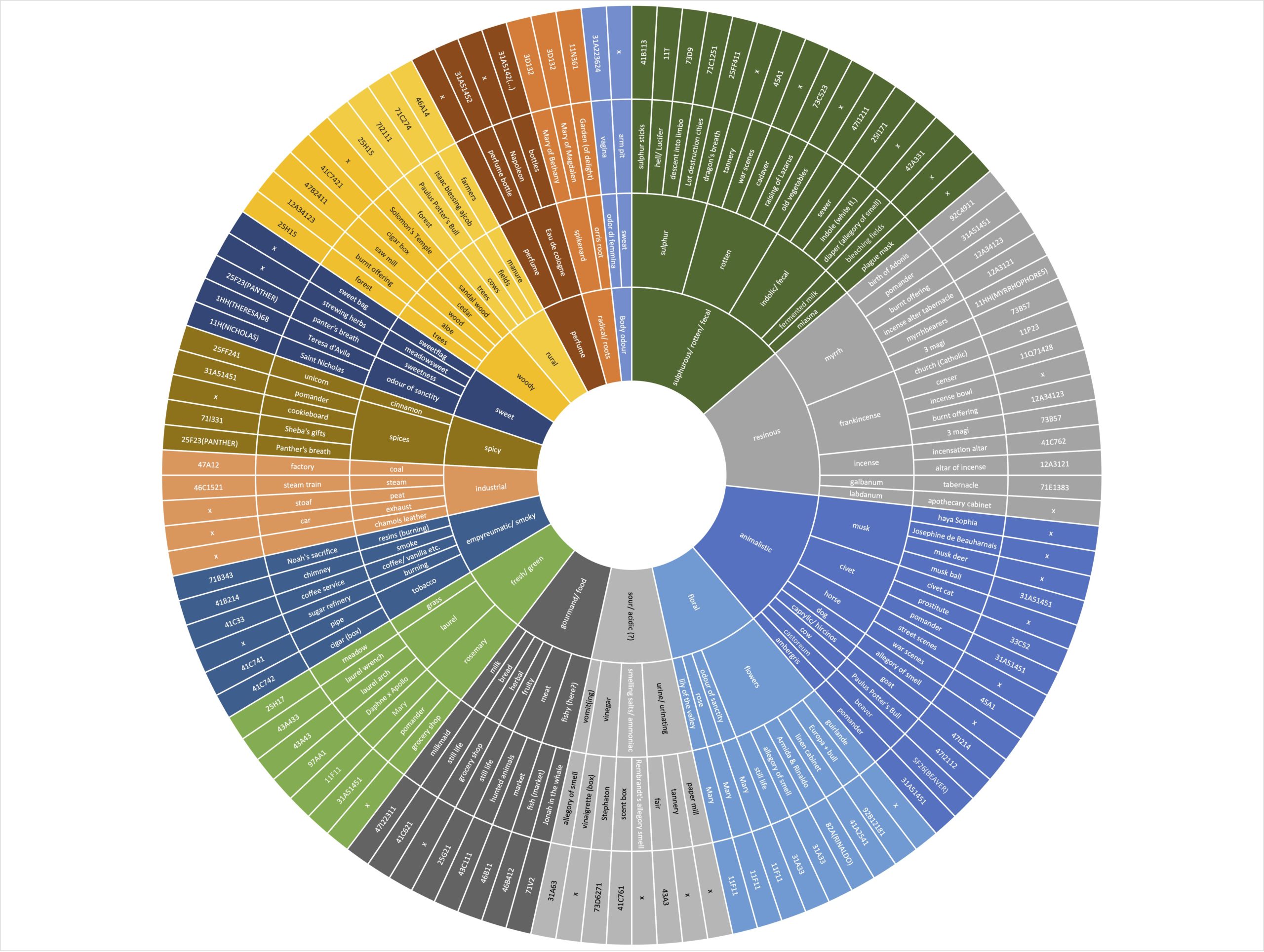
Here's one of their ongoing projects, seen in the picture above, an odor wheel based on art historical references to smells: The Odeuropa Art Historical Scent Wheel from the Mediamatic Aroma Lab.

The Odeuropa “Nose first art historical odour wheel” starting from scent families in the centre, connected to odorants in the second ring, and then to artworks and artefacts around that, ending with an outer ring with Iconclass codes. Iconclass is a multilingual online database that museums use to tag historical images and artworks. -link

This wheel is based on imagery like paintings that were then coded with words, allowing a machine-readable dataset of odors, which will become increasingly more popular as we apply this approach to larger and more recent datasets, such as the Wikimedia Commons, or the running corpus of Instagram's zero-liked images.
 
Speaking of datasets, there are many to choose, from dog breeds to aerial photographs to 3 million "Clickbait, spam, crowd-sourced headlines from 2010 to 2015," to "4,000 physical dimensions of abolone." Wikimedia commons has 7.5 million images.

Looking back at the odor wheel, there are some interesting associations here. But they do reflect the dataset. I'm having a hard time finding details on Iconoclass but it was developed by one person in the 1950's, and based I assume on Western Art. It's currently maintained by RKD Netherlands Institute for Art History.

Here's some examples -- "street scenes and horses;" not a common conjunction in today's world. "Unicorns and cinnamon," anyone? "Prostitutes and civet," less unexpected. The two "body odors" are armpit and vagina, fyi. 

The most interesting part of all this? The lead researcher Sofia Ehrich has "become familiar with detecting depictions of smell." She can smell words and pictures. 

And speaking of words and pictures: 
Ocularcentric - like a visual bias, like we as humans tend to have an ocularcentric view of the world, with our trichromatic vision and fancy visual cortices, etc. 

Notes:
Mediamatic (in Amsterdam) is an art centre dedicated to new developments in the arts since 1983. We organize lectures, workshops and art projects, focusing on nature, biotechnology and art+science in a strong international network.

IconoClass dataset -  specialized library classification designed for art and iconography.

Lifting One's Hat

Layers of IconClass system

This is an example of the layers of the IconoClass system, pretty deep stuff. You can see how the image has words attached to it, making it a machine-readable cultural object. This is how we will teach robots of the future how to better understand us, and maybe we can even teach them how to smell.

Mario Klongmann x BigGAN - 2019

Mostly Unrelated Post Script:
An AI Artist’s Twitter Feed Is an Art Gallery
The images and videos Mario Klingemann posted under the hashtag #BigGAN can only be appreciated by treating his Twitter feed as a digital exhibition. (Images taken from the ImageNet dataset)
Feb 2019, Hyperallergenic


This AI Creates Art From Instagram Posts With Zero Likes
“Zero Likes” is trained to create glitchy visuals from forgotten social media images.
May 2017, Vice

Melbourne artist and coder Sam Hains created Zero Likes, an AI trained to respond only to those lost and lonely images that miss out on attention.

Friday, April 23, 2021

Fragrance Book of the Year 2021

The Essence: Discovering the World of Scent, Perfume & Fragrance


It's back -- the de facto fragrance compendium for the modern world has risen from beneath the pandemic infopocalypse to be nominated as Fragrance Book of the Year for 2021. 

Released in Europe in late 2019, then in the United States in early 2020, this book was immediately overshadowed by the pandemic, and has now come back to life. 

Nominated by the Perfumed Plume, it stands against the legendary author of culinary bible On Food and Cooking, Harold McGee, who just released his second major book in over 30 years. His new book is called Nose Dive: A Field Guide to the World of Smells. This is stiff competition for a book that could have been one of the earliest victims of the COVID-19 pandemic.

The Perfumed Plume has been awarding fragrance journalism and fragrance books since 2016. They shine a spotlight on writing that both informs and entertains us, offering an engaging view into the oftentimes clandestine, esoteric world of fragrance and olfactory experience. 

They couldn't have picked a better book for that. Described by Fragrantica editor John Biebel as a "highly aesthetic experience," The Essence is a 288-page, full color, hardcover, stitch bound book full of essays, research, inforgraphics, interviews, histories and photographs. The book is a world unto itself. Without reading a single word, this is one of the most beautiful books you'll ever hold. (Bias alert: I did contribute two essays to this book.)

The publisher, Die Gestalten Verlag, is known for their 600 books on art, architecture, design, photography and typography, and is the only publisher where all the editors are designers. And it shows. You put this book on your coffeetable and you might never leave your apartment again. (Sarcasm alert: some of us are still on lockdown due to the pandemic and can't leave our apartments anyway.) 

It's a visually compelling time capsule of fragrance, art, and history rolled into one thick volume. ... Also featured are many revealing essays about culture and smell, such as "The Smell of Fear", "Gender and Identity", and "The Future of Scent". The editorial finesse in a project like "Essence" comes about through the keen balance of compelling graphics, thorough research, and a "something for everyone" approach to content.
The Essence: Discovering the World of Scent, Perfume & Fragrance, edited by Robert Klanten, founder and CEO of gestalten as well as Carla Seipp, fragrance writer, is the first publication by gestalten recognizing the world of scent and the figures who shape the field.

Written in the pre-covid era, February 2020


Tuesday, February 4, 2020

The Designer's Coffeetable


I am very excited to announce a new book about scent that comes out any day now.

It's called The Essence: Discovering the World of Scent, Perfume & Fragrance, and it's being published by Die Gestalten Verlag, who is known for their 600 books on art, architecture, design, photography and typography.

The book is a compendium of fragrance and includes some of the most provocative and important people in the world of smell. It's filled with interviews, stories, essays and data candy about the most understudied of senses. I was lucky enough to contribute a couple essays on the neuromechanics of smell and the smell of the human body. 

Having spent the majority of my career instructing on the principles and elements of visual design, I must say, this book is a visual powerhouse. I would read it just for the sake of looking at the typography, those curves.

Gestalten is the only publisher where all the editors are professional designers. And it definitely shows. From the photographs to the layout to that airtight, neo-Bauhaus, Leger-esque cover, this whole book is a barbituate-drip to the visiopathic ocd cultural consumer. 

What's even better -- it's not about visual design at all; it's about the wide-open world of olfactory indulgence!

I'll let the press department take over from here:

About the Book
The empire of scent: explore the realm of perfumes, smells, and aromatic incense to reveal the enduring allure of fragrance. Scent is a hugely under-studied sense, compared with the other senses, both neurologically and psychologically.

Scents are linked with our most cherished memories of life without the ability to smell is unimaginable. The Essence: Discovering the World of Scent, Perfume & Fragrance contains meticulous research on the mystery of scents, profiles of those pushing the envelope of science and fantasy, and the history of a royal pursuit that have shaped the perfume industry into what it is today. From the lavender fields of Provence and the laboratories where perfumes are created, to incense producers in India.

Meet the trailblazers shaping the future of perfumery as The Essence explores the vital role that technology and scented products will play in the 21st century. A study in 2014 by researchers at the University of Lyon found that aging human stress levels were reduced and moods improved by manipulating the environment with a pleasant odor. There will be a revolution in the health and wellness industries, where a renewed focus on the conscious and subconscious power of scent has gained traction in recent years.
According to Olivia Jezler, the founder of design and fragrance innovation consultancy, Future of Smell, "Scents will be used to enhance cognition, to retain and recall information and even to control the way we feel and experience the world."
What to Expect
All you wish and need to know about the perfume and fragrance industry. Where are the scents from? Why are they so important for us? Who are they designed for and by whom? Investigates fragrance families, raw materials from different regions of the world, the chemistry of smelling, the interaction between smelling and memory.

Featuring designers, start-ups, creative artisans, and manufactories, from young independent perfumers experimenting with genuinely natural fragrances to brands developing artificial scents for their products.

Including a guide to the best perfume meccas worldwide. With essays, interviews, stories, infographics and stunning photography.
“Smell is the deepest sense, it is rooted in our limbic system. It is the old, animal part of our brain, the center where emotions rise and where memories are located."
-Wolfgang Georgsdorf, artist and founder of the Osmodrama festival in Berlin
***
The Essence: Discovering the World of Scent, Perfume & Fragrance, edited by Robert Klanten, founder and CEO of gestalten as well as Carla Seipp, fragrance writer, is the first publication by gestalten recognizing the world of scent and the figures who shape the field.

Find the book here on gestalten’s page, under New Releases.

Tuesday, November 26, 2019

On the Designer's Coffeetable


I am very excited to announce a new book about scent coming out on November 26 in the EU. (February 11 in the US.)

It's called The Essence: Discovering the World of Scent, Perfume & Fragrance, and it's being published by Die Gestalten Verlag, who is known for their 600 books on art, architecture, design, photography and typography.

It's filled with interviews, stories and encyclopedic information from some of the most interesting and important people in the world of smell. I was also lucky enough to contribute a couple essays on the neuromechanics of smell and the smell of the human body.

Having spent the majority of my career instructing on the principles and elements of visual design, I must say, this book is a visual powerhouse.

Gestalten is perhaps the only publisher where all the editors are professional designers. And it definitely shows. From the photographs to the layout to that airtight, neo-Bauhaus, Leger-esque cover, this whole book is a barbituate-drip to the visiopathic ocd cultural consumer.

What's even better -- it's not about visual design at all; it's about the wide-open world of olfactory indulgence!

I'll let the press department take over from here:

About the Book
The empire of scent: explore the realm of perfumes, smells, and aromatic incense to reveal the enduring allure of fragrance. Scent is a hugely under-studied sense, compared with the other senses, both neurologically and psychologically.

Scents are linked with our most cherished memories of life without the ability to smell is unimaginable. The Essence: Discovering the World of Scent, Perfume & Fragrance contains meticulous research on the mystery of scents, profiles of those pushing the envelope of science and fantasy, and the history of a royal pursuit that have shaped the perfume industry into what it is today. From the lavender fields of Provence and the laboratories where perfumes are created, to incense producers in India.

Meet the trailblazers shaping the future of perfumery as The Essence explores the vital role that technology and scented products will play in the 21st century. A study in 2014 by researchers at the University of Lyon found that aging human stress levels were reduced and moods improved by manipulating the environment with a pleasant odor. There will be a revolution in the health and wellness industries, where a renewed focus on the conscious and subconscious power of scent has gained traction in recent years.
According to Olivia Jezler, the founder of design and fragrance innovation consultancy, Future of Smell, "Scents will be used to enhance cognition, to retain and recall information and even to control the way we feel and experience the world."
What to Expect
All you wish and need to know about the perfume and fragrance industry. Where are the scents from? Why are they so important for us? Who are they designed for and by whom? Investigates fragrance families, raw materials from different regions of the world, the chemistry of smelling, the interaction between smelling and memory.

Featuring designers, start-ups, creative artisans, and manufactories, from young independent perfumers experimenting with genuinely natural fragrances to brands developing artificial scents for their products.

Including a guide to the best perfume meccas worldwide. With essays, interviews, stories, infographics and stunning photography.
“Smell is the deepest sense, it is rooted in our limbic system. It is the old, animal part of our brain, the center where emotions rise and where memories are located."
-Wolfgang Georgsdorf, artist and founder of the Osmodrama festival in Berlin
***
The Essence: Discovering the World of Scent, Perfume & Fragrance, edited by Robert Klanten, founder and CEO of gestalten as well as Carla Seipp, fragrance writer, is the first publication by gestalten recognizing the world of scent and the figures who shape the field.

Find the book here on gestalten’s page, under New Releases.