Showing posts with label culture. Show all posts

Tuesday, June 13, 2023

The Olfactory Determinants of Culture


First direct evidence that babies react to taste and smell in the womb
Oct 2022, phys.org

4D ultrasound -- Fetuses exposed to carrot showed more "laughter-face" responses while those exposed to kale showed more "cry-face" responses.

via Durham University: Flavour Sensing in Utero and Emerging Discriminative Behaviours in the Human Fetus, Psychological Science (2022). DOI: 10.1177/09567976221105460


Ancient humans had same sense of smell, but different sensitivities
Jan 2023, phys.org

"We had the odorant receptor genomes from Neanderthal and Denisovan individuals and we could compare them with today's humans and determine if they resulted in a different protein."

So then they tested the responses of 30 lab-grown olfactory receptors from each hominin against a battery of smells to measure how sensitive each kind of receptor was to a particular fragrance.

The laboratory tests showed the modern and ancient human receptors were essentially detecting the same odors, but their sensitivities differed.

Denisovans -- less sensitive to floral, better at sulfur, balsamic, and honey

Neanderthals -- less responsive to green, floral and spicy scents

via Duke University: Claire A. de March et al, Genetic and functional odorant receptor variation in the Homo lineage, iScience (2022). DOI: 10.1016/j.isci.2022.105908


Reminder that "mummy fever" was a thing back in the 1800's and it was a big deal to break out the mummy meat for your esteemed guests, because nothing identifies the top tier of society like eating small fragrant bits of ancient humans:
Teasing out the secret recipes for mummification in ancient Egypt
Feb 2023, Ars Technica

The results: “We could identify a large diversity of substances which were used by the embalmers,” co-author Maxime Rageot of the University of Tübingen told New Scientist. Those substances included oils or tars from juniper, cypress, or cedar; various resins, including some from Pistacia trees; and animal fats, beeswax, and plant oils. Most of those have been found before in mummies, but two resins—dammar and elemi—have not been previously identified anywhere in Egypt before. They also found bitumen from the Dead Sea. -via New Scientist


Thursday, November 17, 2022

Everyone Likes Vanilla


People around the world like the same kinds of smells
Apr 2022, phys.org

Odor preference is molecular. People share odor preferences regardless of cultural background. Traditionally it has been seen as cultural.

First of all, the thumbnail for this article, of the girl smelling the flower in profile view, is used every time a smell article comes up on phys.org.
Girl Smelling a Flower in Profile - Petr Kratochvil

So I ran it through the Stable Diffusion library at lexica.art, "girl smelling a flower in profile," and got top image above, what I'll call "Woman Eating a Flower by William-Adolphe Bouguereau and Gustav Klimt" [link]

Second of all, look that the list of collaborators here -- this is not your average smell study:

Department of Clinical Neuroscience at Karolinska Institutet, School of Life Sciences at Arizona State, Centre for Languages and Literature at Lund, Department of Anthropology at University College London, Colegio de Ciencias Sociales y Humanidades at Universidad San Francisco de Quito in Ecuador, Instituto de Investigaciones Filológicas at the National Autonomous University of Mexico, School of Languages and Linguistics at University of Melbourne, Monell Chemical Senses Center, Department of Neuroscience at University of Pennsylvania (Asifa Majid as corresponding author)
The secret? 

Many of the researchers are field workers working with indigenous populations. For this present study, the researchers selected nine communities representing different lifestyles: four hunter-gatherer groups and five groups with different forms of farming and fishing. Some of these groups have very little contact with Western foodstuffs or household articles.

"Since these groups live in such disparate odiferous environments, like rainforest, coast, mountain and city, we captured many different types of 'odor experiences'," says Dr. Arshamian.
The results:

The study included a total of 235 individuals, who were asked to rank smells on a scale of pleasant to unpleasant. The results showed variation between individuals within each group, but global correspondence on which odors are pleasant and unpleasant. The researchers showed that the variation is largely explained by molecular structure (41 percent) and by personal preference (54 percent). 

^One other study measured about 30% difference between any two people, this now says 54%, just keeping track.

The odors the participants were asked to rank included vanilla, which smelled best. This was followed by ethyl butyrate, which smells like peaches. The smell that most participants considered the least pleasant was isovaleric acid, which can be found in many foods, such as cheese, soy milk and apple juice, but also in foot sweat.

I think we knew vanilla was the universally liked odor, but this study is likely more reliable. 

via Karolinska Institutet, University of Oxford, Lund University, Stockholm University, University College London, Arizona State University, Monell Chemical Senses, Universidad San Francisco de Quito (Ecuador), University of Melbourne, and National Autonomous University of Mexico: Artin Arshamian, Richard C. Gerkin, Nicole Kruspe, Ewelina Wnuk, Simeon Floyd, Carolyn O’Meara, Gabriela Garrido Rodriguez, Johan N. Lundström, Joel D. Mainland, Asifa Majid, The perception of odor pleasantness is shared across cultures, Current Biology (2022). DOI: 10.1016/j.cub.2022.02.062

AI Art - Emma Watson in a Tunic Holding a Flower by Rubens - 2022
Emma Watson wearing green tunic holding a flower. Painted by Rubens, high detail [link]

Post Script:
(Personal opinion not backed by science) I think cultural influence on odor preference only works for bad smells, and specifically the "quantum hedonic" smells like parmesan cheese, kimchi, durian fruit, etc. That's where the signal is for cultural influence (and if put in the same dataset as vanilla and peaches would get lost).

Thursday, November 10, 2022

The Past Doesn't Smell Like It Used To


Scientists find ways to study and reconstruct past scents
Apr 2022, phys.org

They're trying to develop "an archaeology of scent," which is hard because smells are ephemeral, and last only as long as their source. But because of advances in chromatography, mass spectrometry, sequencing technologies and modern bioinformatics, which include metabolomics, proteomics and genomics; they can identify the organic remains preserved on surfaces like walls, ceramic vessels, incense burners, perfume flasks, cooking pots, dental calculus, mummies, and entire streets:

Advanced biomolecular and ‘omics’ sciences enable more direct insights into past scents, offering new options to explore critical aspects of ancient society and lifeways as well as the historical meanings of smell.

The whole paper is very interesting, and although I encourage anyone interested in ancient history to read it, for those who don't, I bring back only this -- palaeofaeces -- it's a thing in archaeology, and now in olfactory archaeology too: "in an Iron Age roundhouse in Scotland, chemical characterization of floor sediments provided insight into living conditions, hygiene practices and the temporary sheltering of animals in human living areas during this period."
-Mackay, H. et al. J. Archaeol. Sci. 121, 105202 (2020). [pdf]

via the Department of Archaeology at the Max Planck Institute for the Science of Human History in Jena, Germany: Huber, B., Larsen, T., Spengler, R.N. et al. How to use modern science to reconstruct ancient scents. Nat Hum Behav 6, 611–614 (2022). https://doi.org/10.1038/s41562-022-01325-7

via James Gilleard and Justin Gerard

Post Script:
Speaking of human history, the Odeuropa project is taking a completely different angle -- they use computer science to identify, scrape, and coordinate pictures that contain smells in them, either by visually recognizing objects tagged as related to smells, or by reading the text captioned with the image. Sensory mining they call it:

Odeuropa is a European research project which bundles expertise in sensory mining and olfactory heritage. We develop novel methods to collect information about smell from (digital) text and image collections.

Thursday, June 16, 2022

Word Avoidance


Did you just say what I think you said?

No, because this tree actually smells like semen, but nobody will ever say that out loud, or in print, so instead they call it rotting fish.

Tree that smells like rotting fish is so invasive states are offering bounties to kill it
Dec 2021, Bangor Daily News

And they're talking about the Bradford pear tree, which sucks as a tree, and is a great example of how good marketing can destroy the planet (or at least your charming downtown neighborhood).

Somebody was really successful circa the 1990's at selling these trees to urban planners looking to revitalize their downtowns with nice shade trees that have infrastructure-friendly root structures and "they even bloom pretty white flowers!" (that smell like a handful of hot semen for a couple weeks out of the year). The problem is that they only live about 30 years, they're brittle so their limbs break off easily, they're invasive so they make the soil inhospitable to other plants, and they multiply ferociously when you try to cut them down. Also their flowers smell like semen when they bloom, but nobody will tell you that, because nobody wants to say out loud that anything smells like semen. In fact, if you, for example, were anosmic to semen, you might go your entire life without knowing, because nobody ever talks about it. 

The Victorians would have called it "a man smell."

Post Script:
Also see the Tree of Heaven (Ailanthus altissima), which is another invasive and foul-smelling tree.

Thursday, August 12, 2021

Odeuropa's Olfactory Iconographies

€2.8M grant for research project on European olfactory heritage and sensory mining:

Odeuropa bundles expertise in sensory mining and olfactory heritage. We develop novel methods to collect information about smell from digital text and image collections. They will identify and trace olfactory information in text and image datasets using AI, and promote Europe’s tangible and intangible cultural heritage.

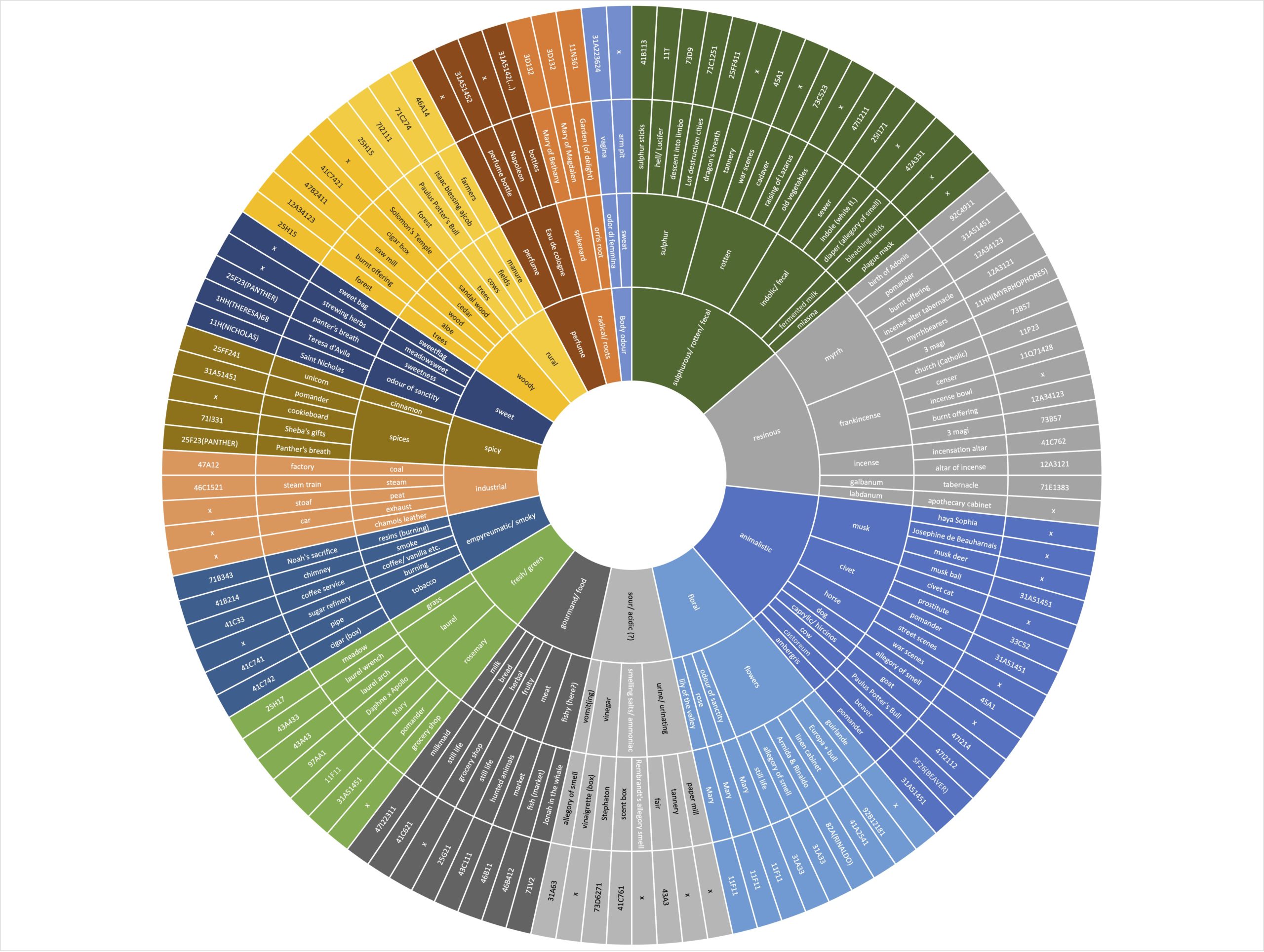
Here's one of their ongoing projects, seen in the picture above, an odor wheel based on art historical references to smells: The Odeuropa Art Historical Scent Wheel from the Mediamatic Aroma Lab.

The Odeuropa “Nose first art historical odour wheel” starting from scent families in the centre, connected to odorants in the second ring, and then to artworks and artefacts around that, ending with an outer ring with Iconclass codes. Iconclass is a multilingual online database that museums use to tag historical images and artworks. -link

This wheel is based on imagery like paintings that were then coded with words, allowing a machine-readable dataset of odors, which will become increasingly more popular as we apply this approach to larger and more recent datasets, such as the Wikimedia Commons, or the running corpus of Instagram's zero-liked images.
 
Speaking of datasets, there are many to choose, from dog breeds to aerial photographs to 3 million "Clickbait, spam, crowd-sourced headlines from 2010 to 2015," to "4,000 physical dimensions of abolone." Wikimedia commons has 7.5 million images.

Looking back at the odor wheel, there are some interesting associations here. But they do reflect the dataset. I'm having a hard time finding details on Iconoclass but it was developed by one person in the 1950's, and based I assume on Western Art. It's currently maintained by RKD Netherlands Institute for Art History.

Here's some examples -- "street scenes and horses;" not a common conjunction in today's world. "Unicorns and cinnamon," anyone? "Prostitutes and civet," less unexpected. The two "body odors" are armpit and vagina, fyi. 

The most interesting part of all this? The lead researcher Sofia Ehrich has "become familiar with detecting depictions of smell." She can smell words and pictures. 

And speaking of words and pictures: 
Ocularcentric - like a visual bias, like we as humans tend to have an ocularcentric view of the world, with our trichromatic vision and fancy visual cortices, etc. 

Notes:
Mediamatic (in Amsterdam) is an art centre dedicated to new developments in the arts since 1983. We organize lectures, workshops and art projects, focusing on nature, biotechnology and art+science in a strong international network.

IconoClass dataset -  specialized library classification designed for art and iconography.

Lifting One's Hat

Layers of IconClass system

This is an example of the layers of the IconoClass system, pretty deep stuff. You can see how the image has words attached to it, making it a machine-readable cultural object. This is how we will teach robots of the future how to better understand us, and maybe we can even teach them how to smell.

Mario Klongmann x BigGAN - 2019

Mostly Unrelated Post Script:
An AI Artist’s Twitter Feed Is an Art Gallery
The images and videos Mario Klingemann posted under the hashtag #BigGAN can only be appreciated by treating his Twitter feed as a digital exhibition. (Images taken from the ImageNet dataset)
Feb 2019, Hyperallergenic


This AI Creates Art From Instagram Posts With Zero Likes
“Zero Likes” is trained to create glitchy visuals from forgotten social media images.
May 2017, Vice

Melbourne artist and coder Sam Hains created Zero Likes, an AI trained to respond only to those lost and lonely images that miss out on attention.

Friday, April 23, 2021

Fragrance Book of the Year 2021

The Essence: Discovering the World of Scent, Perfume & Fragrance


It's back -- the de facto fragrance compendium for the modern world has risen from beneath the pandemic infopocalypse to be nominated as Fragrance Book of the Year for 2021. 

Released in Europe in late 2019, then in the United States in early 2020, this book was immediately overshadowed by the pandemic, and has now come back to life. 

Nominated by the Perfumed Plume, it stands against the legendary author of culinary bible On Food and Cooking, Harold McGee, who just released his second major book in over 30 years. His new book is called Nose Dive: A Field Guide to the World of Smells. This is stiff competition for a book that could have been one of the earliest victims of the COVID-19 pandemic.

The Perfumed Plume has been awarding fragrance journalism and fragrance books since 2016. They shine a spotlight on writing that both informs and entertains us, offering an engaging view into the oftentimes clandestine, esoteric world of fragrance and olfactory experience. 

They couldn't have picked a better book for that. Described by Fragrantica editor John Biebel as a "highly aesthetic experience," The Essence is a 288-page, full color, hardcover, stitch bound book full of essays, research, inforgraphics, interviews, histories and photographs. The book is a world unto itself. Without reading a single word, this is one of the most beautiful books you'll ever hold. (Bias alert: I did contribute two essays to this book.)

The publisher, Die Gestalten Verlag, is known for their 600 books on art, architecture, design, photography and typography, and is the only publisher where all the editors are designers. And it shows. You put this book on your coffeetable and you might never leave your apartment again. (Sarcasm alert: some of us are still on lockdown due to the pandemic and can't leave our apartments anyway.) 

It's a visually compelling time capsule of fragrance, art, and history rolled into one thick volume. ... Also featured are many revealing essays about culture and smell, such as "The Smell of Fear", "Gender and Identity", and "The Future of Scent". The editorial finesse in a project like "Essence" comes about through the keen balance of compelling graphics, thorough research, and a "something for everyone" approach to content.
The Essence: Discovering the World of Scent, Perfume & Fragrance, edited by Robert Klanten, founder and CEO of gestalten as well as Carla Seipp, fragrance writer, is the first publication by gestalten recognizing the world of scent and the figures who shape the field.

Written in the pre-covid era, February 2020


Tuesday, October 20, 2020

Mummy Meat


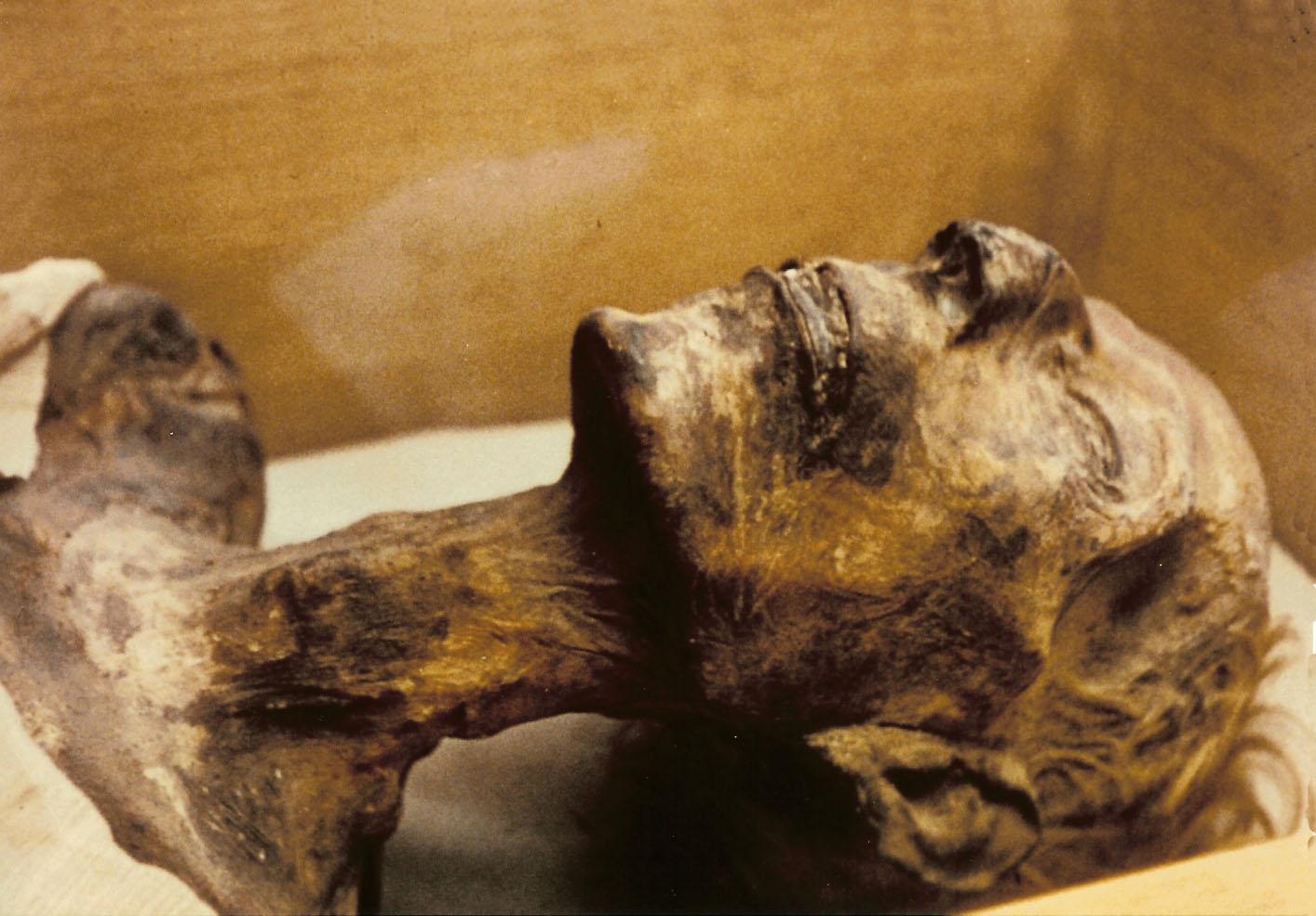
People used to eat mummies.

Last week for the first time, I saw someone else writing about this, but in the spirit of the season, which is Halloween here in the US. Good time for a perennial favorite here at Limbic Signal:

A while back I discovered that people with lots of money and imagination were eating preserved human bodies to get high, about 200 years ago.

I thank Annick Le Guérer for this tidbit, she wrote about it in her book Scent, the Mysterious and Essential Powers of Smell, written in 1988, and translated from French in 1994.

There was a time, we must remember, when mummies were a new thing, never before imagined by the Westerners excavating these immortalized bodies. It's hard to conjure the pretense of shock at something that has been around since long before you were born.

For a moment if you will, try to imagine what it would have been like to learn that deep within the awe-striking pyramidal limestone masses were 3,000-year old physically intact human bodies. This at a time before we had refrigerators! We couldn't even keep a bowl of potato salad from going bad in a couple days, and here's an entire human body with its skin still intact, and older than the entire city in which you live.*

That's magic to a person of the 19th century. Today, our tupperware will probably last longer than our species itself, nevermind the bodies we leave behind. We have plastic flowers for goodness sake. But if you can transport yourself back to a time where everything was ephemeral, you can begin to understand the fascination.

And the exoticism. The preserving substances used on mummies were much less known to Europeans hundreds of years ago. Today we can fly from London to Cairo in four hours. Then, it could have taken up to a month. Today we can have in our pantry any spice produced in any place in the world, within a few days. Things were different then. Egypt in itself was pretty exotic, and mummies, forgetaboutit.

So if you can now picture yourself at an all-nighter in a regal estate, well after midnight, deep into the spirits, when your host spreads on the table these tiny morsels of dry-aged royalty from another era, and who might as well be from another planet, and tells you to dig in – you will be intoxicated. The meat doesn’t make you intoxicated, of course; the idea is enough to placebo the heck out of your dopamine receptors.

I get into the details of how smells are so good at tricking us in this older post. But if you're interested in throwing your own mummy-party, these folks from the University of York have decoded the ancient recipe:

Mummy
-a plant oil –  possibly sesame oil;
-a "balsam-type" plant or root extract that may have come from bullrushes;
-a plant-based gum - a natural sugar that may have been extracted from acacia;
-crucially, a conifer tree resin, which was probably pine resin

*Note that this isn't entirely true, for we have known for a long time about preserving things. Many of the same substances used to preserve mummies also preserve our food. Also note, however, that roughly speaking the practice of using spices to preserve food decreases as you move from the equator, with those places tending to use fermentation as a means of preservation instead, which is the opposite of using spices – one keeps microbial activity at bay, and the other uses it on purpose to regulate the rate of decay. Fermenting mummies would not have worked as well. But that’s pretty tangential, and a transparent excuse to say fermented mummies.

** Know that Europeans are not entirely unfamiliar with mummies; they’re called relics, and they’re not nearly as old.

***Finally, preserving the dead is not the most uncommon thing ever; Japan has a long history of it.


Post Script:
Embalming was just one aspect of preservation. Other steps included:
-Removal of the brain - possibly using a "whisking" process to cause the brain to liquefy
-Removal of the internal organs
-Putting the body into a natural salt to dry it out
-Coating the body in the embalming recipe , to kill bacteria and to seal it
-Wrapping the body in linen


Notes:
Aug 2018, BBC

Nov 2016, Limbic Signal

Feb 2016, Network Address

Apr 2017, Network Address

Japanese Mummies

Tuesday, February 4, 2020

The Designer's Coffeetable


I am very excited to announce a new book about scent that comes out any day now.

It's called The Essence: Discovering the World of Scent, Perfume & Fragrance, and it's being published by Die Gestalten Verlag, who is known for their 600 books on art, architecture, design, photography and typography.

The book is a compendium of fragrance and includes some of the most provocative and important people in the world of smell. It's filled with interviews, stories, essays and data candy about the most understudied of senses. I was lucky enough to contribute a couple essays on the neuromechanics of smell and the smell of the human body. 

Having spent the majority of my career instructing on the principles and elements of visual design, I must say, this book is a visual powerhouse. I would read it just for the sake of looking at the typography, those curves.

Gestalten is the only publisher where all the editors are professional designers. And it definitely shows. From the photographs to the layout to that airtight, neo-Bauhaus, Leger-esque cover, this whole book is a barbituate-drip to the visiopathic ocd cultural consumer. 

What's even better -- it's not about visual design at all; it's about the wide-open world of olfactory indulgence!

I'll let the press department take over from here:

About the Book
The empire of scent: explore the realm of perfumes, smells, and aromatic incense to reveal the enduring allure of fragrance. Scent is a hugely under-studied sense, compared with the other senses, both neurologically and psychologically.

Scents are linked with our most cherished memories of life without the ability to smell is unimaginable. The Essence: Discovering the World of Scent, Perfume & Fragrance contains meticulous research on the mystery of scents, profiles of those pushing the envelope of science and fantasy, and the history of a royal pursuit that have shaped the perfume industry into what it is today. From the lavender fields of Provence and the laboratories where perfumes are created, to incense producers in India.

Meet the trailblazers shaping the future of perfumery as The Essence explores the vital role that technology and scented products will play in the 21st century. A study in 2014 by researchers at the University of Lyon found that aging human stress levels were reduced and moods improved by manipulating the environment with a pleasant odor. There will be a revolution in the health and wellness industries, where a renewed focus on the conscious and subconscious power of scent has gained traction in recent years.
According to Olivia Jezler, the founder of design and fragrance innovation consultancy, Future of Smell, "Scents will be used to enhance cognition, to retain and recall information and even to control the way we feel and experience the world."
What to Expect
All you wish and need to know about the perfume and fragrance industry. Where are the scents from? Why are they so important for us? Who are they designed for and by whom? Investigates fragrance families, raw materials from different regions of the world, the chemistry of smelling, the interaction between smelling and memory.

Featuring designers, start-ups, creative artisans, and manufactories, from young independent perfumers experimenting with genuinely natural fragrances to brands developing artificial scents for their products.

Including a guide to the best perfume meccas worldwide. With essays, interviews, stories, infographics and stunning photography.
“Smell is the deepest sense, it is rooted in our limbic system. It is the old, animal part of our brain, the center where emotions rise and where memories are located."
-Wolfgang Georgsdorf, artist and founder of the Osmodrama festival in Berlin
***
The Essence: Discovering the World of Scent, Perfume & Fragrance, edited by Robert Klanten, founder and CEO of gestalten as well as Carla Seipp, fragrance writer, is the first publication by gestalten recognizing the world of scent and the figures who shape the field.

Find the book here on gestalten’s page, under New Releases.

Monday, January 20, 2020

Did You Smell That No I Didn't


aka The 378-Dimensional Individual Olfactory Receptor Subtype Genome
aka The Olfactory Fingerprint


I would like to go back to Conspiracy Keanu on this one, because I know you feel the same way.

It's pretty hard to tell if the Blue you see is the same Blue I see. (And The Dress is still fresh enough in our collective memory to know how this plays out.)

For the most part, we can be sure that when we're detecting energy in the 610-670 THz range, it will be called Blue by anyone who knows what Blue means (which is not everyone; check this out for a lesson on the cultural evolution of color terms).

Smells however, not the same. Isovaleric Acid is the best example of this, because half the people who smell it will call it delicious and the other half disgusting. So we have differences in opinion, big deal. But there's more – we are not perceiving the same thing.

That is to say, the hundreds of chemically-sensitive receptors in our nose, which are programmed by hundreds of genes in our personal genome, they're pretty personal. And they can be quite different from person to person, with as high as a 30% variation. This means the actual receptors encoding molecular features into our minds are not all the same. This isn't just about subjectivity; the actual hardware is different from person to person. 

General olfactory acuity will change based on age, gender, smoking habits, body type, and race. Other factors such as prior upper respiratory infection, trauma, and environmental toxin exposure are also involved. Even something as simple as prior exposure to an odor can change the way we perceive it (in the case of androstenone). Not only that, the same odor will smell different to the same person at different times!

With all that variation, how do we ever really know what each other is talking about? My androstenone is not your androstenone. A great study from a powerhouse in olfactory research was done back in 2012 to characterize these perceptual differences across a diverse metropolitan population, and I'm summarizing it here because without it, all other smell research is kind of useless.

The Study
They gave 66 different odors to 391 people who closely reflected the diverse population of New York City (meaning that this study group has a fighting chance of representing the diversity of the human genome).

The Findings
·      Young, female, non-smoking subjects had the highest average olfactory acuity.
·      Deviations from normal body type in either direction were associated with decreased olfactory acuity.
·      General olfactory acuity declines with age.
·      Reduced general olfactory acuity can be caused by genetics, trauma, exposure to toxic agents, neurodegenerative diseases, or infections.

Differences in Olfactory Acuity Between Races
·      African-Americans 149
·      Asians 231
·      Caucasians 225
·      (Asians are more similar to each other, and African-Americans are more different)

On Hedonics, i.e., Pleasant vs Unpleasant
·      Unpleasant odours were generally perceived to be more intense than pleasant odours
·      Across all subjects, the eight most pleasant odours were food odours such as vanilla, citrus, minty, and cinnamon odours
·      The seven least pleasant odours were fatty acid derivatives associated with the sour smell of rancid butter or body odour
·      The biggest variability in pleasantness perception was found for floral odours
·      The two most pleasant stimuli were the two concentrations of ethyl vanillin, followed by the high concentration of vanillin
·      The least liked odor was isovaleric acid (rancid butter) and isobutyraldehyde (sour)
·      Throughout our subject population, odours perceived to be most and least pleasant were remarkably stable
·      For 18 of the 134 stimuli the pleasantness rating differed significantly between African-American and Caucasian subjects
·      The biggest difference between younger and older subjects was that older subjects perceived anise, the odour of liquorice, to be more pleasant
*I thought this one was easy, since I know that most candy experience by someone born in ~1930 came from licorice, and that changes pretty drastically thereafter; the first Twizzler flavor was licorice, not strawberry, which didn't appear until the late 1970's.
·      Men vs Women: there are older studies that show differences, but these were not reproduced in this study, instead, new sets: For guaiacol, the odour of wood smoke, both concentrations were perceived to be significantly more pleasant by men. The high concentration of guaiacol showed the largest difference between men and women
·      All the odours that were perceived to be more pleasant by perfume users were odours used in perfumes (pentadecalactone, heptyl acetate, octyl aldehyde, nonyl aldehyde); Perfume use may result in these odours being rated as more pleasant, or, alternatively, those who perceive these odours to be more pleasant are more likely to use perfumes.
·      Geranyl acetate (floral, rose, lavender) was perceived to be more pleasant by Caucasians than by Asians
·      Androstenone was more likely to smell “musky” and “aromatic” to women, whereas men found it to be more “chemical” and “sickening,”

Further Findings
Interestingly, for any given stimulus, the responses were as similar when the ratings were spaced over one year apart as when they were around 30 minutes apart.

This may seem surprising, but for thresholds it has even been reported that the variability within a day is significantly larger than the variability between days [1]. Day-to-day variability in olfactory perception is therefore largely a consequence of sniff-to-sniff variability.

The main causes of within-individual variability are processes that operate on the scale of seconds or minutes such as changes in the stimulus signal-to-noise ratio [2] or the reallocation of attention by the subject [3], rather than on the scale of hours or days, such as hormonal changes or infections of the upper respiratory tract.
1. Stevens JC, Cain WS, Burke RJ. Variability of olfactory thresholds. Chem Senses. 1988;13:643–653. doi: 10.1093/chemse/13.4.643.
2. Cain WS. Differential sensitivity for smell: “noise” at the nose. Science. 1977;195:796–798. doi: 10.1126/science.836592.
3. Keller A. Attention and olfactory consciousness. Front Psychol. 2011;2:380.

Demography
·      Males have been shown to be more sensitive to the odour bourgeonal (lily-of-the-valley); also the only known odour that men are more sensitive to than women.
Olsson P, Laska M. Human male superiority in olfactory sensitivity to the sperm attractant odorant bourgeonal. Chem Senses. 2010;35:427–432. doi: 10.1093/chemse/bjq030.
·      African-Americans have been shown to have a higher threshold for isovaleric acid than Caucasians, but a lower threshold for pentadecalactone.
Whissell-Buechy D, Amoore JE. Odour-blindness to musk: simple recessive inheritance. Nature. 1973;242:271–273. doi: 10.1038/242271a0.
·      Asians perceive each odour of the homologous series of nonyl aldehyde, decyl aldehyde, and undecanal to be stronger than Caucasians (no mechanistic explanation for this).
·      The three stimuli showing the greatest variability between subjects in intensity ratings were the high concentrations of androstenone and androstadienone, and methanethiol (cabbage-like odour present in urine of people who have previously ingested asparagus).

Specific Odorants – Androstenone and Androstadienone
·      Altered by genetic variation in the odorous steroid-sensitive odorant receptor OR7D4.
Keller A, Zhuang H, Chi Q, Vosshall LB, Matsunami H. Genetic variation in a human odorant receptor alters odour perception. Nature. 2007;449:468–472. doi: 10.1038/nature06162.
Lunde K, Egelandsdal B, Skuterud E, Mainland JD, Lea T, Hersleth M, Matsunami H. Genetic variation of an odorant receptor OR7D4 and sensory perception of cooked meat containing androstenone. PLoS One. 2012;7:e35259. doi: 10.1371/journal.pone.0035259.
Knaapila A, Zhu G, Medland SE, Wysocki CJ, Montgomery GW, Martin NG, Wright MJ, Reed DR. A genome-wide study on the perception of the odorants androstenone and galaxolide. Chem Senses. 2012;37:541–552. doi: 10.1093/chemse/bjs008.
·      Androstadienone was perceived to be stronger by older subjects, women and African-Americans.
·      The functional RT variant of OR7D4 is more common in African-Americans.
·      This is consistent with the finding from the National Geographic Smell Survey.

Specific Odorants – Methanethiol
Associated with a single nucleotide polymorphism within a 50-gene cluster of olfactory receptors.
Pelchat ML, Bykowski C, Duke FF, Reed DR. Excretion and perception of a characteristic odor in urine after asparagus ingestion: a psychophysical and genetic study. Chem Senses. 2011;36:9–17. doi: 10.1093/chemse/bjq081.
Tung JY, Do CB, Hinds DA, Kiefer AK, Macpherson JM, Chowdry AB, Francke U, Naughton BT, Mountain JL, Wojcicki A. et al.Efficient replication of over 180 genetic associations with self-reported medical data. PLoS One. 2011;6:e23473. doi: 10.1371/journal.pone.0023473.
Eriksson N, Macpherson JM, Tung JY, Hon LS, Naughton B, Saxonov S, Avey L, Wojcicki A, Pe’er I, Mountain J. Web-based, participant-driven studies yield novel genetic associations for common traits. PLoS Genet. 2010;6:e1000993. doi: 10.1371/journal.pgen.1000993.

Specific Odorants – Pentadecalactone, Vanillin and Isovaleric Acid
·      Perceived as more intense by non-perfume users.

Notes
Any two individuals differ by 30% of their olfactory receptor subtype genome:
Genetic variation across the human olfactory receptor repertoire alters odor perception. C. Trimmer, A. Keller, N. R. Murphy, L. L. Snyder, J. R. Willer, M. H. Nagai, N. Katsanis, L. B. Vosshall, H. Matsunami, and J. D. Mainland. PNAS p9475-9480 v116 n19. https://doi.org/10.1073/pnas.1804106115. https://www.pnas.org/doi/abs/10.1073/pnas.1804106115
Genetic variation in a human odorant receptor alters odour perception. Keller A, Zhuang H, Chi Q, Vosshall LB, Matsunami H. Nature. 2007 Sep 27;449(7161):468-72. doi: 10.1038/nature06162. Epub 2007 Sep 16. PMID: 17873857. https://pubmed.ncbi.nlm.nih.gov/17873857/


The human olfactory genome contains 418 intact odorant receptor genes and their 912,912 intact odorant receptor alleles:
The 1000 Genomes Project (2008-2015), the largest public catalogue of human variation and genotype data.

378-dimensional individual olfactory receptor subtype genome:
Individual olfactory perception reveals meaningful nonolfactory genetic information.
Secundo L, Snitz K, Weissler K, Pinchover L, Shoenfeld Y, Loewenthal R, Agmon-Levin N, Frumin I, Bar-Zvi D, Shushan S, Sobel N. Proc Natl Acad Sci U S A. 2015 Jul 14; 112(28):8750-5.

Androstenone perception is heavily influenced by prior exposure:
Wysocki CJ, Dorries KM, Beauchamp GK. Ability to perceive androstenone can be acquired by ostensibly anosmic people. Proc Natl Acad Sci U S A. 1989;86:7976–7978. doi: 10.1073/pnas.86.20.7976.

Study on inter-individual variability:
An olfactory demography of a diverse metropolitan population.
Keller A, Hempstead M, Gomez IA, Gilbert AN, Vosshall LB
BMC Neurosci. 2012 Oct 10; 13():122.