Showing posts with label language. Show all posts

Monday, April 7, 2025

Body Odor Perceptronics


We have a winner - this article has a year's worth of stuff to look into. 

An aromatic lexicon: Comprehensive fragrance database offers insights into human perception of odors
Feb 2025, phys.org

University of Jena and Technical University of Dresden's Olfactorial Perceptronics Fundamental Odor Database - The project brings together various research disciplines: psychology, physics, chemistry, materials science, and medicine. For the database, they had more than 1,200 test subjects smell 74 monomolecular odor samples, then describe what they perceived with their nose in their own words and also used a rating scale to assess, among other things, how pleasant or intense they found the respective odor. 
Public-access app (German language only) https://crown-dataset.streamlit.app/

University of Jena and colleagues from Finland, Israel and the Czech Republic Smart Electronic Olfaction for Body Odor Diagnostics or SMELLODI - The researchers asked 2,600 test subjects in 17 countries how they would describe the odor of individual parts of the body and how it differs when a person is ill or has been exercising. This resulted in a catalogue of descriptions for various odors in 13 languages, which produces clear overlaps and thus allows general statements to be made about how certain areas of the body smell. The test subjects perceived armpit odor as sweaty, sour and stinky, they described bad breath as either fresh or stinky and foot odor as cheesy.


Here's a sample of the Standardized Lexicon of Body Odor Words, in English:
  • "healthy" - fresh, clean, neutral, sweet, natural
  • "after exercise" - sweaty, strong, salty, sour, musky, ... wet,
  • "from the mouth" - food, rotten, minty, sour, foul, gross, garlicky, fresh, strong, 
  • "from the feet" - sweaty, sour, cheesy, stinky, pungent, strong, dirty, smelly, bad
  • "from the female genitals" - fishy, sour, sweet, musky, ... metallic, ... salty, 
  • "from the male genitals" - sweaty, musky, salty, musty, sour, cheesy, stale, urine, ... fishy, 
  • "stressed" - sweaty, sour, strong, pungent, stinky, sharp, salty, 
  • "from the armpit" - sweaty, strong, sour, musky, salty, sweet, ...

via University of Jena and TU Dresden: Antonie Louise Bierling et al, A dataset of laymen olfactory perception for 74 mono-molecular odors, Scientific Data (2025). DOI: 10.1038/s41597-025-04644-2

Also: Antonie L. Bierling et al, A standardized lexicon of body odor words crafted from 17 countries, Scientific Data (2025). DOI: 10.1038/s41597-025-04630-8


Thursday, February 1, 2024

Interpersonal Olfactory Intelligence


One of the few people who really understands the intersection of language and smell, and what they mean for the truly scientific pursuit of knowledge in a field of study that refuses to submit to objective observation --

Meditations on Scent With Andreas Keller, the Socrates of Smell
Mar 2023, High Snobiety

"It’s very difficult to find a middle ground in talking about smell that conveys what's interesting and fascinating to you in a way that other people can understand,” Keller notes. “The limited vocabulary, the differences in perception between people, the emotional connection to smells… One way is to describe what a smell does to you, how it makes you feel – but that probably tells us more about yourself than about the smell.”

Unrelated image credit: This is not a picture of Andreas Keller, and it's not even a real person, because it's artificially generated. It's a "Rave Party for Jesus Birthday." Also pay artists for their work. 


Thursday, December 7, 2023

Subjective Olfactory Perception


Two reasons why we aren't good at talking about smells -- 1. we don't share a common percept, and 2.  
we don't share a common language for smells. 

We're genetically coded to perceive smells differently from one another, with a round number at 30% difference across a population. As far as smelling goes, you could say that many of us are mutants. Or you could say there is no "normal" and therefore no mutant. It's just part of the process of evolution. Because of this difference in smell receptors caused by changes in the genes, there are holes in our perception of smells, holes from a societal level, and so the statistics makes it so that the quality of the data, each individual's perception of an odor combined to that of a group of people, is not so good. 

Next, we don't share a common language for smells. Some of this comes from the above problem, but some of it comes from that fact that lots of smells are "social smells" and so the way we talk about them is first and foremost determined by social context, not by some objective characteristic of the smell itself. An example, sort of related, is that we don't talk about the smell of shit in public, it's just not good manners. Or another person's body odor, or the smell of semen, which is almost never ever ever written, not even the word, in general popular literature (in English; maybe this isn't the case in other languages but I don't know).

These two studies below bring some interesting additions to this idea, that the part of our brain that perceives odors is mediated by a pleasure-reward part of our brain, and that language itself comes in two kinds, social and non-social:


Study sheds light on the neural underpinning of subjective odor perceptions
Sep 2023, phys.org

Participants rated 160 odors on 18 perceptual descriptors while under fMRI analysis -- the  orbitofrontal cortex is where the most detailed and subjective percepts reside, and not as much with the amygdala and piriform cortex, regions typically associated with odor processing. 

via Northwestern University, Rhodes College, University of Pennsylvania and NIH National Institute on Drug Abuse: Vivek Sagar et al, High-precision mapping reveals the structure of odor coding in the human brain, Nature Neuroscience (2023). DOI: 10.1038/s41593-023-01414-4


Social vs. language role: Researchers question function of two brain areas
Sep 2023, phys.org

Language just got way more complicated:

"A research team led by Prof. Lin Nan from the Institute of Psychology of the Chinese Academy of Sciences found that during sentence processing, the neural activity of two canonical language areas—the left ventral temporoparietal junction (vTPJ) and the lateral anterior temporal lobe (lATL)—is associated with social-semantic working memory rather than language processing per se."

These regions were sensitive to sentences only if the sentences conveyed social meaning. 

These findings are likely to force a major reconsideration of the functional organization of the cortical language network.

via Institute of Psychology of the Chinese Academy of Sciences: Zhang, G. et al, A social-semantic working-memory account for two canonical language areas, Nature Human Behaviour (2023). DOI: 10.1038/s41562-023-01704-8.

Tuesday, June 21, 2022

Neuroplasticity


This story keeps getting crazier the further you read. 

Woman with no left temporal lobe developed a language network in the right side of her brain
Apr 2022, phys.org

A woman without a left temporal lobe developed a language network in the right side of her brain that allowed her to communicate normally. She only came to realize she had an unusual brain by accident—her brain was scanned in 1987 for an unrelated reason. 

By all accounts she behaved normally, earning an advanced degree and excelling in languages—she speaks fluent Russian—which is all the more surprising considering the left temporal lobe is the part of the brain most often associated with language processing.

It was likely the woman had lost her left temporal lobe as a child, probably due to a stroke. The area where it had been had become filled with cerebrospinal fluid. To compensate, her brain had developed a language network in the right side of her brain that allowed her to communicate normally.

She also had a sister who was missing her right temporal lobe, and who also had no symptoms of brain dysfunction—an indication, the researchers suggest, that there is a genetic component to the stroke and recovery process in the two women.

via MIT, Carnegie Mellon University, UCLA and Harvard: Greta Tuckute et al, Frontal language areas do not emerge in the absence of temporal language areas: A case study of an individual born without a left temporal lobe, Neuropsychologia (2022). DOI: 10.1016/j.neuropsychologia.2022.108184

See this similar study on smell:
Left-handed women can have normal olfaction without apparent olfactory bulbs, and scientists are very confused.

via the Weizmann Institute: Human Olfaction without Apparent Olfactory Bulbs. Tali Weiss, Noam Sobel, et al. Neuron, volume 105,  issue 1, page 35-45.E5, Jan 2020. DOI:https://doi.org/10.1016/j.neuron.2019.10.006


Thursday, June 16, 2022

Word Avoidance


Did you just say what I think you said?

No, because this tree actually smells like semen, but nobody will ever say that out loud, or in print, so instead they call it rotting fish.

Tree that smells like rotting fish is so invasive states are offering bounties to kill it
Dec 2021, Bangor Daily News

And they're talking about the Bradford pear tree, which sucks as a tree, and is a great example of how good marketing can destroy the planet (or at least your charming downtown neighborhood).

Somebody was really successful circa the 1990's at selling these trees to urban planners looking to revitalize their downtowns with nice shade trees that have infrastructure-friendly root structures and "they even bloom pretty white flowers!" (that smell like a handful of hot semen for a couple weeks out of the year). The problem is that they only live about 30 years, they're brittle so their limbs break off easily, they're invasive so they make the soil inhospitable to other plants, and they multiply ferociously when you try to cut them down. Also their flowers smell like semen when they bloom, but nobody will tell you that, because nobody wants to say out loud that anything smells like semen. In fact, if you, for example, were anosmic to semen, you might go your entire life without knowing, because nobody ever talks about it. 

The Victorians would have called it "a man smell."

Post Script:
Also see the Tree of Heaven (Ailanthus altissima), which is another invasive and foul-smelling tree.

Friday, March 11, 2022

Somatic Semantics


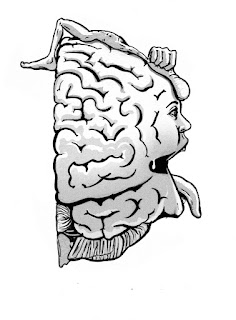
The above image was illustrated by Joe Scordo for Hidden Scents circa 2014, and based on the 1950's illustrations credited to Penfield and Rasmussen, which is need of an update, no?

Brain computer interface turns mental handwriting into text on screen
May 2021, phys.org

My rudimentary understanding of the brain says that the patterns coming from you head when you use any form of motor control would be much easier to see that patterns from simply visualizing letterforms. Something about the somatosensory cortex anatomical map.

For the first time, researchers have deciphered the brain activity associated with trying to write letters by hand. Working with a participant with paralysis who has sensors implanted in his brain, the team used an algorithm to identify letters as he attempted to write them. Then, the system displayed the text on a screen—in real time.

via Howard Hughes Medical Institute: High-performance brain-to-text communication via handwriting, Nature (2021). DOI: 10.1038/s41586-021-03506-2

Post Script:

'Rough' words feature a trill sound in languages around the globe
Jan 2022, phys.org

"They demonstrate a deep-rooted and widespread association between the sounds of speech and our sense of touch."" -Mark Dingemanse, Co-author and Associate Professor in Language and Communication at Radboud University

Also, kiki bouba.

via Radboud University, home of the Limbic Signal patron saint Asifa Majid: Bodo Winter et al, Trilled /r/ is associated with roughness, linking sound and touch across spoken languages, Scientific Reports (2022). DOI: 10.1038/s41598-021-04311-7

Why writing by hand makes kids smarter
Oct 2020, phys.org

"The use of pen and paper gives the brain more 'hooks' to hang your memories on. Writing by hand creates much more activity in the sensorimotor parts of the brain. A lot of senses are activated by pressing the pen on paper, seeing the letters you write and hearing the sound you make while writing. These sense experiences create contact between different parts of the brain and open the brain up for learning. We both learn better and remember better," says Van der Meer.

via Norwegian University of Science and Technology: Eva Ose Askvik et al. The Importance of Cursive Handwriting Over Typewriting for Learning in the Classroom: A High-Density EEG Study of 12-Year-Old Children and Young Adults, Frontiers in Psychology (2020). DOI: 10.3389/fpsyg.2020.01810

Thursday, October 14, 2021

Neuromorphic Odor Translator Helps Robots Express Their Feelings


Neural network trained to properly name organic molecules
Aug 2021, phys.org

Do you ever have a problem naming that smell? It's not just you. Science has this problem too, but maybe not for long. 

Smells are volatile organic compounds that have evaporated and entered your nose. Although they almost always occur in combination with others and not in isolation, us humans want to reduce smells to their individual components, and then name them. After all, in order to think about something, you have to know it's name. (Is that true?) 

The problem is that organic molecules are big, with lots of chemicals joined together in lots of ways, so coming up with a naming convention for all these permutations is hard. IUPAC, the International Union of Pure and Applied Chemistry, sets the convention for naming molecules. And boy is it complicated.

Take sugar, a common molecule known to us by its simple name "sucrose;" in IUPAC, it's called (2R,3R,4S,5S,6R)-2-[(2S,3S,4S, 5R)-3,4-dihydroxy-2,5-bis(hydroxymethyl)oxolan-2-yl]oxy-6-(hydroxymethyl)oxane-3,4,5-triol.

Since we do live in the computer age, folks want to automate this naming process for when they discover new molecules. But as you can imagine by looking at the IUPAC name for sucrose, the algorithm at the core of that naming convention is really hard to write. So they decided to use a neural network instead.*

*I'm casually calling a neural network "neuromorphic," but in the past few years, real neuromorphic computers have forced a distinction here that I'm ignoring here for the sake of a more clickable title. 

This new artificially intelligent chemical translator is not a magical structure-to-name translator that can just look at a chemical and give it a name; that's still out of reach. It does, however, translate between IUPAC and another naming convention called SMILES.

Trained on PubChem's 100 million molecules, this translator ultimately shows how the utility of the new approach of using neural networks to help us write algorithms from the bottom up instead of the top down, which really is a revolution in computing. 

And if you think it would be cool to have robots that can smell, or to ensure that future humans maintain their sense of smell as they evolve into hyperdimensional algorithms, then making odors machine-readable is how you do that.

via Skolkovo Institute of Science and Technology, Lomonosov Moscow State University and start-up Syntelly: Lev Krasnov et al, Transformer-based artificial neural networks for the conversion between chemical notations, Scientific Reports (2021). DOI: 10.1038/s41598-021-94082-y

Saturday, August 1, 2020

The Tree of Heaven

The ghetto palm in its natural habitat

The Tree of Heaven* is also known by its international colloquial name, the Ghetto Palm,  because it thrives in the worst conditions. It's been intentionally brought to the New World from Asia for centuries, both for its exotic ornamental qualities, and its basic use as a fast-growing shade tree that reaches up to the vast ecosystem in the sky at an exceptional rate.
*Also called ailanthus, varnish tree, and chouchun (Chinese, foul-smelling tree).

Now it's considered an invasive species. Its unstoppable juggernaut root system crumbles anything made of concrete, from sewers to foundations to highways and bridges. It also crowds out indigenous species by releasing a toxin (ailanthone) into the soil via its roots and fallen leaves. It isn't affected by herbicide; it is the herbicide.

At this time of year, in the heat of summer, it's spreading like wildfire. Not only does it produce an extraordinary amount of seeds, but it sprouts from its indomitable lateral roots, and almost 100 feet away from the source tree. You don't even have to look for it; you will know it's there by its smell. If you don't know, you will in a minute.

The Tree of Heaven smells bad. Like what? "Bad," that's what.

Can you be a little more descriptive?

Not really. We are so bad at describing bad smells. In fact, the corpus of words used in olfactory science is skewed way to the good. We have many more words for good smells than we do for bad. There's a few reasons for this, one being that we don't like to think about bad smells long enough to generate descriptors. When it comes to bad smells, "objectionable" "disagreeable" "noxious" "offensive" and "smells like shit" will suffice.

We already don't talk about smells much as it is; why waste that precious sensory indulgence on things that smell bad? We also don't like to talk about bad smells, because it can get socially complicated. You're not going to mention a bad smell while with your boss, and that's in case they are the source of it! We don't want to make them look bad. It's also too personal. It's just good social etiquette in general to not talk about bad smells, at all.


We also don't stop and take a second whiff when something smells bad. Flowers yes, the Tree of Heaven no. It will activate your disgust response, you'll reflexively twist your head back, flare your nostrils, and curl your upper lip. And you will not be going back for seconds.

Unless you're me. I've been trying to smell the Tree of Heaven for years now. It was introduced to me circa 2008 by a friend who lived on a farm; we were touring his property. "We call it the jizz tree," he said with a nervous giggle, him and his girlfriend. I don't remember smelling it, maybe it wasn't in season, who knows. I don't remember seeing it either. I don't remember anything except that there's a tree that smells like semen.

Later on I wrote a book about the language of smell, and shortly after that I came to the realization that I'm anosmic to putrescene, which means I cannot smell semen. Smellblind. People are smellblind to all kinds of things, bad things more often it seems, and roughly half of us are anosmic to something (natural gas and rotten fish will come up a lot, because they're talked about a lot, because it's a safety issue, right?).

I'll bet there's less people that know they're anosmic to putrescene. There are some people who are completely anosmic to everything, from birth, and don't realize it until they're ten years old. Kids don't even know that they have a sense of smell, and they certainly don't notice if it goes away temporarily, as in the case of those infected with the novel coronavirus of 2019 (the condition will present as them skipping meals and not being hungry, but it's likely because they can't smell).

Back to the tree. I started to notice the Tree of Heaven invading my extended neighborhood once I began taking the train for school. They grow along the train tracks really well, and they grow fast. After an extreme weather event, like drought, flood or fire, they are the first to pop back up, because they go dormant into their roots, conserve resources, and wait. They looked strange to me only because they were growing so fast. Within the first year of my taking the train, they had already grown from 5 to 20 feet. I started to notice them elsewhere, and once I started to look, there they came; these things are everywhere.

I looked them up, and found this notable characteristic -- this is the famed semen tree I've been hearing about, but never smelled. But it could be sumac, they look pretty darn close. In fact, the easiest way to identify it is to break off a leaf at the stem and smell it. If your head snaps back, it's the Tree of Semen, I mean Heaven. I went outside and grabbed a leaf, and as expected, couldn't smell anything. It could also be sumac; although it turns out I was wrong. 

Months later, I see one on the street and decide to try again, and rip off a leaf. It smells, kind of bad, maybe not, definitely not noxious, is it chocolate? Bad chocolate? What does that even mean? I must investigate further, because there's something there, although it's faint. Maybe it's just the beginning of the right season, who knows. Maybe it's still sumac.

A couple weeks later, it's getting hotter, a 12-day heat wave which is rare where I live, and I'm waiting in a parking lot for my laundry to finish (you can't wait inside, because of the virus). I'm in the back of the parking lot, against the train tracks, where there's shade, from the shade trees... There, I see it again... and now it's everywhere, I take a piece, break it off, and my goodness. My head snaps back. Terribly offensive.

I look it up again -- sumac makes red bunches of fruit, tree of heaven makes neutral colored and later in season pink to reddish-colored seed pods that kind of like maple tree "helicopter" seeds. I now confirm it is in fact the Tree of Heaven. And so is that what semen smells like? I call it pungent burnt rancid oily and dare I say, nutty, like peanuts?
Ailanthus samara seed pod, The Pennsylvania Flora Project of Morris Arboretum, 2011

How come when I look this up, in the more reputable sources such as the New Jersey Audubon Society or the Ecological Landscape Alliance, they use words like rancid peanut butter, burnt rubber, pungent, foul, and the the indispensable "smelly."

Is it because they're so "reputable" that they can't say "semen?" I think this may be half of it.

But as I go further into the informal investigation of the internet rabbit hole (this is called gray literature research, although you should probably call it reading urban dictionary entries, VICE articles and horticulturist blogs), and it starts to dawn on me. These descriptors are a mess; they're all over the place:
Rancid peanut butter, rancid peanuts, rancid cashews, cross between peanut butter and cat urine, well-used gym socks, yucky cooked meat, objectionable, disagreeable to humans, fetid-smelling, bitter, acrid, pungent, strong, and any word that refers to semen, and which can be described as a "chlorine musk," but is more directly associated with the molecule putrescene ... there's something in here about amines and ammonia also. You could also refer to it in your most prudent Victorian manner and call it simply "a man smell."
*Only the male flower smells, but both smell when their branches or stems are broken.
When I look at that list I am reminded of two things -- we are really bad at describing bad smells, and half of us are anosmic to something, and usually to bad smells.

So not only do we NOT talk about or think about the names to call bad smells, but for some of them, we can't even smell them in the first place.

When you don't talk about something, and you don't generate either a personal or a shared vocabulary for something, you will be really bad at identifying it, at discriminating it from similar things, or at categorizing it in your autobiographical database. This means you're more likely to mis-assign a name to the smell, calling plant-semen "dirty gym socks" instead. I may need some help here, because again, I'm smellblind to it, but does semen smell like dirty gym socks?

Furthermore, when you're presented with a cocktail of bad smells, as would be expected emanating from a living biochemical reactor*, you may be missing a major component of the mixture due to smellblindness to one of the molecules, and that could change your impression dramatically.
*A plant's essential oil is not the same as an isolated synthetic compound, because olfaction is a combinatorial affair, shown from about 2015 research and on.

If you combine all these factors together, you get one dirty mess of a database. There is no absolute, no discrete points. If you could manage to ask 10,000 people around the world  (or 1.5 million in the National Geographic Smell Survey) to describe 10 different bad smells, each a natural biologically-generated smell cocktail, what would that list look like?

That list would tell you something about the overall distribution of genetic diversity in the study population based on olfactory receptor genes, or it could tell you something about the cultural milieu of a sub-sample (like the Victorians!), but it won't tell you any better what the Tree of Heaven "really" smells like, or stink bugs for that matter.

When it comes to making sense of the world as an olfactory phenomenon, you're on your own. Olfactory reality is not a consensual reality. And that's unsettling, because in the Information Age, approximation seems like failure, no?


Post Script: 
Within days of my most recent experience with the potent odor of this tree, I can now smell it as a drive down the highway, from the trees on the side of the road. In my typical self-induced pseudo-hyperosmic fashion, I have become very sensitive to it.

This reminds me of an idea about regeneration of olfactory neurons and combinatorial perception, and as it relates to people recovering from the novel coronavirus of 2019. After some traumatic disturbance to your olfactory neurons, like from being attacked by a virus, you may experience changes in smell or taste. This is also called anosmia, partial anosmia, or phantosmia, the last referring to not a loss of smell but a change in the way things smell.

Phantosmia, like all phenomena in olfactory science, is not understood enough to say much from an evidenced-based point of view. I'm making a broad speculation here, not to explain, but to make someone interested enough that they will investigate further for themselves, and maybe even initiate more research into the topic.

The change in smell that comes from phantosmia is common, but its origins are often overlooked. It likely signals a change in the structure of neurons used to smell. These are the only part of your brain that pass the blood-brain barrier and rest outside your skull, in the mucous atop the epithelium skin way up in the top of your nostril canal (right where they swab that sample for your PCR test by the way, and not a coincidence). These neurons are thus both very vulnerable to damage, and able to regenerate indefinitely.

Combine this with another fact about olfaction -- it is combinatorial. That means when you smell "apple," there are a bunch of different receptors all lighting up in a pattern that means "apple." There is no Apple gene. For some there are, but for the most part, no. No single gene codes for any single cell. Olfaction is all gestalt. Take one piece out, and the entire picture gets weird as hell. Something's wrong but you can't tell what. So your brain misfires, it says "cigarette smoke" when it's really something else entirely. But after damage to your system, it is re-learning how to smell. Your nose-brain is a deep learning neural network that requires countless iterations to "learn" what a smell is. And while it's relearning after an infection, it gets confused.

In a very mild manner, and for reasons I will attribute to having been infected myself, my Tom Ford Italian Cypress lost its depth and presented as cinnamon and bubblegum, for about three days. If you've ever smelled Italian Cypress (and if not good luck it's discontinued since 2014), you would know that it does NOT smell like cinnamon and bubble gum. That's happened to me once before, and I will now assume it was because I was then also infected with a virus. But I got lucky, it wasn't bad, just weird.

And another thing -- when faced with new smells, we tend to call them bad. After repeated exposure, we can start to see them as good, but it's more likely we call them bad at first. So if your system is relearning how to smell, then lots of typical odor exposures will present as "bad" to you, simply by their being new, that is, new to your newly developing system. And all of the sudden, anything that doesn't compute properly on your new system will become "cigarette smoke," for example. Rotten meat is another good one for this, but it could be anything really (and it could also be really debilitating, just imagine.)

Eventually, the system will recalibrate and relearn how to smell, and you'll be back to normal. But that doesn't always happen. Blunt trauma can kill those neurons forever. Really bad infections too. Sometimes it doesn't come back because you're not using it, like therapy after a stroke, it only comes back if you try really hard to use it.

And some of us, well, we're just getting older. Things don't work like they used to. And not only that, changes in smell can predict all kinds of neurological diseases decades in advance (Parkinson's, Alzheimer's, etc.).

All this being said, my system has apparently, and finally, learned how to smell the Tree of Heaven.


Some good recent research on genetic variation in olfactory receptors:
Did You Smell That No I Didn't
Jan 2020, limbicsignal.com

And the most relevant among them for today:
Any two individuals differ by ∼30% of their olfactory receptor subtype genome.
Mainland JD, et al. (2014) The missense of smell: Functional variability in the human odorant receptor repertoire. Nat Neurosci 17(1):114–120.
https://www.ncbi.nlm.nih.gov/pubmed/24316890
https://www.ncbi.nlm.nih.gov/pmc/articles/PMC3990440/

The human olfactory genome contains 418 intact odorant receptor genes and their 912,912 intact odorant receptor alleles.
The 1000 Genomes Project (2008-2015), the largest public catalogue of human variation and genotype data.
https://www.internationalgenome.org

Pop Search Trivia:
"Tree of heaven smells" like peanut butter, #1 search result. (July 2020)

What is the tree that smells like dead fish?
(Callery pear trees)

What is the tree that smells like peanut butter?
(Butterfly tree or peanut butter shrub)

What are other trees that smell?

  • Callery pear, Bradford pear tree - flowers emit dead rotten fish semen trimethylamine dimethylamine
  • Maidenhair, Ginkgo bioloba tree - female fruit produces putrid rotten eggs vomit
  • Chinese chestnut tree - male flowers emit "off-putting" smell; again I think this smells like semen and it's just not said that way because it's uncouth!
  • Linden tree - smells like semen? How could it smell like semen and yet someone else says it smells like the most powerful fragrance in the plant kingdom, of honey and lemon peel?

Notes:

Best source of information on this topic:
Ecological Landscape Alliance - Tree of Heaven, An Exotic Invasive Plant Fact Sheet - May 2014

Identify and Disambiguate:
New Jersey Audubon Society - How to Correctly Distinguish Invasive Tee-of-Heaven from Native Sumac - July 2018

Post Post Script:
This gal is trying to decode the bad smell network; I made an odor descriptor-molecule network graph of her research with a regional air quality odor complaint database, interesting work, under-explored territory.

In word-searching the list from the Curren's study, "amine" turns up "fishy" and "pungent" via trimethylamine, and "pungent" via ammonia; no mentions of semen ever.

"Pungent" then brings up pentanal, 2-pentanone, formaldehyde, ammonia, trimethylamine. And  "rancid" connects to butyric acid. "Rotten" brings the expected hydrogen sulfide and dimethyl trisulfide from "rotten eggs" and "rotten vegetables."

A Case Study of Odor Nuisance in the South Coast Air Quality Management District 
Curren, J. 2012. Characterization of Odor Nuisance. UCLA.

What the Hell Does a Stink Bug Smell Like?


Tuesday, April 14, 2020

On the Power of Words


I thought this article about "Keyword Signaling" would be a good one to put here, because it shows us the power of words in today's world. (And the only thing more interesting to Limbic Signal than smells is words.)

With the omni-depository that is the Internet, and the text-based search engines we use to interface with it, words have taken on a new meaning in our world.

Each word you type into a search box will tailor your online experience to such a degree of specificity that no two forays will be the same.

(Super sidenote, back in the day when Google's predictive search algorithm, as well as our collective psyche, was naked for all to see, you could type "Why does Daddy..." and watch a whole lot of sociology populate your search field; in order, the predictions were "...hit Mommy," "...wear a dress," and...I forget because the first two were enough to make me realize what the Internet had really become. This was circa 2010 maybe. But if you changed the text ever so slightly to say "Why does my Dad..." which suggests an older person conducting the search, both because of the dropping of the diminutive -y but also the adding of the possession "my" which shows that the person is aware they have their own Dad vs other Dads, you would get different predictions, such as "...drink so much." The difference in search terms-results is subtle, but it's baked into the interface.)

The work done by Data and Society Institute's Fracesca Tripoldi shows how this all works and especially how it's being used to manipulate the datasphere.

First you find a data void. That's a topic, or rather a term used as a pointer to a topic, that brings up no search results.

There's no results because nobody is using the term, not necessarily because nobody is talking about the topic. But you come up with that new, unused term, and you create content to go along with it. Like, fake content, conspiracy theory content, propaganda content, salacious content, whatever, and when you slap your new word on there, you now own the search results for that content.

Let's say I want to steer people away from the actual facts about a mass murder at an elementary school, so I create a new term - "crisis actor" - then I generate all kinds of content about people who pretend they were in a mass shooting, and I slap my keyword (crisis actor) all over the content, and THEN I make sure to spread the keyword around as much as possible, so other people start saying it out loud, and then other people will start searching for it, which will weight the results of my keyword.

Guess where they'll end up? They'll end up at my site, reading my content. They won't be swayed by different views of the situation, because the whole idea of the crisis actor, the keyword and the content, was fabricated, it was artifice, and it exists in a vacuum, unconnected to the rest of the world.

When I start with a data void, I can control everything that goes into it, and I can make sure that you never see the other side of the story, because there is no other side. Only my side. It doesn't exist within the actual ecosystem of information. It is a Frankenstein of an info-ecosystem, engineered by me to send you in a very specific direction.

The fact that our global repository of information is accessed by typing words into a searchbox-algorithm leaves it susceptible to such workings. It also leaves out an entire dimension of human sensation, that being olfaction.

How does misinformation and nefarious SEO engineering relate to olfaction? Because smells don't correlate to words as a matter of fact, only as a matter of opinion. Everything you can ever read about smells is already, from the start, "alternative facts," because there were no real facts to begin with. The two - language and smell - they just don't go together. The keyword and the content, they have to be artificial, by the very nature of the sense of smell. The entire human experience in regards to olfaction is one big data void, filled by poets and marketing slogans. That is, until the search box can be filled with emotions and autobiographies.

Notes:
"The problem is, whether or not we’re aware, the key words we search are coded with political biases. My research demonstrates that it’s possible to position ideological searches to maximize the exposure of their content."
—Data & Society Affiliate Francesca Tripodi, WIRED

May 2019, Francesca Tripodi for Data and Society


Friday, November 10, 2017

Ambiguity, Approximation and Probability

Logo (the programming language)

Probabilistic programming does in 50 lines of code what used to take thousands

I wanted to put some stuff up here about the state of computer programming, because the way we smell is akin to a special kind of computer program, and one which does not act like the kind we know.

I should start like this – I grew up on Logo, and then NES video games, therefore my experience with, and thinking upon, computer programming is ‘coded’ according to this top-down style. Someone writes the code, and the computer executes the code. There are no surprises (unless you have bugs to fix). You tell the turtle (that’s what they call the cursor in Logo) what to do and it does exactly that. Look at the picture above. That little triangle (the turtle) was told to go 100 spaces, rotate 90 degrees, then go 100 more spaces, etc, until a square is born.

King Koopa was told to jump every time you throw fireballs at him, or whatever he does. There is no fuzzy logic here. Everything is clear, concise, exact, predictable. (Again, that’s when the program runs as intended; surely this kind of programming is unpredictable when it goes wrong.)

Enter a new kind of programming. With the dual advent of big data and big processors to crunch it, we are seeing a different approach. The computing power is now so capable that it is asked to figure out its own program from the data given. This helps with a lot of the problems faced in computing today. With such variety in the data (this is ultimately what big data is about – not lots of quantity, but lots of different qualities) we can no longer write programs equipped to work with such variety. The program required for that ends up being as big as the dataset.

This is where we see the parallels to smells and olfaction. The amount of smells we could potentially be exposed to is infinite and multifarious. Vision has only a few categories. Things can look light or dark, a binary classification, or they can be categorized by their color on the spectrum, which is a discrete classification. They have a shape, a size, maybe a texture category. Odors, however, cannot be organized this way. There are too many and they are too different from eachother. Therefore, olfactory perception is distinct from our other senses. In order for us to create an artificial intelligence that can smell, we would have to come up with a different kind of programming.

Facial recognition provides a good visual analogy to the olfaction problem. What a face looks like isn’t really dependent on its color or its shape, but the combination of these features, the whole. And that makes a lot of initial parameters, in fact, infinite parameters. Face-rec uses these new types of programs, and they are almost the opposite, in every way, of what programming has been. I’ll let this guy describe them:

“When you think about probabilistic programs, you think very intuitively when you're modeling. You don't think mathematically. It's a very different style of modeling.” … “The code can be generic if the learning machinery is powerful enough to learn different strategies for different tasks.”
- Tejas Kulkarni, an MIT graduate student in brain and cognitive sciences, phys.org

In the same way that we are not born already knowing every smell we will ever encounter, these programs must ‘learn on the fly.’ This is an advance in computing, but also it foreshadows a very different world, where information is not distinct, discrete, exact, etc. It is instead more like that thing you smell but you don’t know what it is, but you swear you know yet you don’t know…you know what I’m talking about? Doesn’t sound like the kind of output your computer would produce.

POST SCRIPT

[lots of good explaining in this article, so I just copied most of it]

A Grand Unified Theory of Artificial Intelligence

Embracing uncertainty

In probabilistic AI, by contrast, a computer is fed lots of examples of something — like pictures of birds — and is left to infer, on its own, what those examples have in common. This approach works fairly well with concrete concepts like “bird,” but it has trouble with more abstract concepts — for example, flight, a capacity shared by birds, helicopters, kites and superheroes. You could show a probabilistic system lots of pictures of things in flight, but even if it figured out what they all had in common, it would be very likely to misidentify clouds, or the sun, or the antennas on top of buildings as instances of flight. And even flight is a concrete concept compared to, say, “grammar,” or “motherhood.”

As a research tool, Goodman has developed a computer programming language called Church — after the great American logician Alonzo Church — that, like the early AI languages, includes rules of inference. But those rules are probabilistic. Told that the cassowary is a bird, a program written in Church might conclude that cassowaries can probably fly. But if the program was then told that cassowaries can weigh almost 200 pounds, it might revise its initial probability estimate, concluding that, actually, cassowaries probably can’t fly.


“With probabilistic reasoning, you get all that structure for free,” Goodman says. A Church program that has never encountered a flightless bird might, initially, set the probability that any bird can fly at 99.99 percent. But as it learns more about cassowaries — and penguins, and caged and broken-winged robins — it revises its probabilities accordingly. Ultimately, the probabilities represent all the conceptual distinctions that early AI researchers would have had to code by hand. But the system learns those distinctions itself, over time — much the way humans learn new concepts and revise old ones.