Showing posts with label words. Show all posts

Tuesday, December 21, 2021

Trans-Epistemological Etymologues - VOC vs VOC


Violating Organic Content - The new VOCs!

For years we have been both addicted to and suspicious of VOCs -- volatile organic compounds. They smell great, like gasoline, baked bread, or bergamot. They can also get into our bloodstream and cause health problems. They evaporate from all kinds of things, and we can measure them with special "VOC meters," although the human nose is by far the most sensitive all-purpose VOC-detector on the market. (Don't forget there are plenty of things that are bad for you that you CAN'T smell at all; and then there's anosmia too.)

But now, a new VOC is on the scene, one potentially far more serious to the survival of our cultural species. They're called "violating organic contents," and they're like little diseases floating around our collective neural network.

Perhaps "floating" is the wrong word. They're jamming your brain via high-frequency algorithms, engineered to reprogram your hardwired hormone circuits of reward and control. Like spores of a Cordyceps mushroom, they invade your neural system, changing the way you think, and using you to propagate itself throughout the network of other-people's-brains. 

You can't smell these VOCs; in fact, even the digital social networks themselves can't seem to detect them very well. We need a better detector for violating organic content (and a better immune system for our collective brain, perhaps some memetic inoculations?). 

Apple threatened Facebook ban over slavery posts on Instagram
Sep 2021, BBC News

Apple threatened to remove Facebook's products from its App Store, after the BBC found domestic "slaves" for sale on apps, including Instagram, in 2019.

"We removed 700 Instagram accounts within 24 hours, and simultaneously blocked several violating hashtags."

It added that it had also developed technology that can proactively find and take action on content related to domestic servitude - enabling it to "remove over 4,000 pieces of violating organic content in Arabic and English from January 2020 to date".

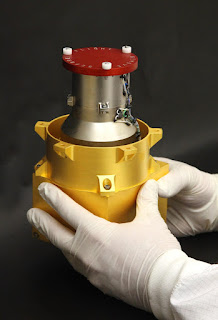
Image credit: That's not a VOC-detector, it's a radiation detector, used by NASA JPL for Mars research.

Partially Related Post Script:
Why cannabis smells skunky
Dec 2021, phys.org

Now, researchers reporting in ACS Omega have discovered a new family of prenylated volatile sulfur compounds (VSCs) that give cannabis its characteristic skunky aroma. 

Prior studies have focused mainly on terpenoids—molecules that range in odor from fuel-like to woody, citrusy or floral.

However, although terpenoids are the most abundant aroma compounds in cannabis, there is little evidence that they provide the underlying skunk-like smell of many cultivars. Skunks use several VSCs in their smelly defense sprays, so Iain Oswald and colleagues suspected that there could be similar molecules in cannabis.

One compound in particular, 3-methyl-2-butene-1-thiol, referred to as VSC3, was the most abundant VSC in the cultivars that the panel reported to be most pungent. This compound has previously been implicated in the flavor and aroma of "skunked beer"—beer that goes bad after being exposed to UV light.

via American Chemical Society: Iain W. H. Oswald et al, Identification of a New Family of Prenylated Volatile Sulfur Compounds in Cannabis Revealed by Comprehensive Two-Dimensional Gas Chromatography, ACS Omega (2021). DOI: 10.1021/acsomega.1c04196


Thursday, October 14, 2021

Neuromorphic Odor Translator Helps Robots Express Their Feelings


Neural network trained to properly name organic molecules
Aug 2021, phys.org

Do you ever have a problem naming that smell? It's not just you. Science has this problem too, but maybe not for long. 

Smells are volatile organic compounds that have evaporated and entered your nose. Although they almost always occur in combination with others and not in isolation, us humans want to reduce smells to their individual components, and then name them. After all, in order to think about something, you have to know it's name. (Is that true?) 

The problem is that organic molecules are big, with lots of chemicals joined together in lots of ways, so coming up with a naming convention for all these permutations is hard. IUPAC, the International Union of Pure and Applied Chemistry, sets the convention for naming molecules. And boy is it complicated.

Take sugar, a common molecule known to us by its simple name "sucrose;" in IUPAC, it's called (2R,3R,4S,5S,6R)-2-[(2S,3S,4S, 5R)-3,4-dihydroxy-2,5-bis(hydroxymethyl)oxolan-2-yl]oxy-6-(hydroxymethyl)oxane-3,4,5-triol.

Since we do live in the computer age, folks want to automate this naming process for when they discover new molecules. But as you can imagine by looking at the IUPAC name for sucrose, the algorithm at the core of that naming convention is really hard to write. So they decided to use a neural network instead.*

*I'm casually calling a neural network "neuromorphic," but in the past few years, real neuromorphic computers have forced a distinction here that I'm ignoring here for the sake of a more clickable title. 

This new artificially intelligent chemical translator is not a magical structure-to-name translator that can just look at a chemical and give it a name; that's still out of reach. It does, however, translate between IUPAC and another naming convention called SMILES.

Trained on PubChem's 100 million molecules, this translator ultimately shows how the utility of the new approach of using neural networks to help us write algorithms from the bottom up instead of the top down, which really is a revolution in computing. 

And if you think it would be cool to have robots that can smell, or to ensure that future humans maintain their sense of smell as they evolve into hyperdimensional algorithms, then making odors machine-readable is how you do that.

via Skolkovo Institute of Science and Technology, Lomonosov Moscow State University and start-up Syntelly: Lev Krasnov et al, Transformer-based artificial neural networks for the conversion between chemical notations, Scientific Reports (2021). DOI: 10.1038/s41598-021-94082-y

Tuesday, May 5, 2020

Semantic Bingo


In olfactory research, there's a test called a pairwise similarity test that's used to measure smells, allowing researchers to construction of a map of odor perception.

It's hard to make sense out of smells; it doesn't work like the rest of our sensory system. For a bunch of reasons it's proven quite difficult to produce a model which predicts how a molecule will be perceived.

It's not broken beyond repair, but it is frustrating because we can never seem to get an airtight model that works for all smells and for all people. With hundreds of different receptors, varying over thousands of alleles, scientists often look somewhere else for the organizing principles -- they look for patterns in the words themselves.

In a study from 2015, distributional semantics is used to create an odor map. They say it's the first attempt to do so. This technique rests on the theory that words occuring in similar contexts are in fact similar. Some of you might remember this as "context clues;" if you come across a new word while you're reading, use the surrounding context to help you guess what the word means.

So instead of trying to make a map of molecular features and receptor actuation potentials, they make a map of the words themselves. They use large text datasets, i.e., really big books, one of which was the Sigma-Aldrich Flavors and Fragrances catalog, then score words based on their co-occurances in the text.

I started this post just so I could paste these lists of words, so let's get on with it. On a scale of 0-1, how likely is it that these words can be interchanged?

Similarity Test:
bakery-bread  0.96
grass-lawn       0.96
dog-terrier      0.90
bacon-meat    0.88
oak-wood        0.84
daisy-violet     0.76
daffodil-rose   0.74

Nearest Neighbor Test:
apple - pear, banana, melon, apricot, pineapple
bacon - smoky, roasted, coffee, mesquite, mossy
brandy - rum, whiskey, wine-like, grape, fleshy
cashew - hazlenut, peanut, almond, hawthorne, jam
chocolate - cocoa, sweet, coffee, licorice, roasted
lemon - geranium, grapefruit, tart, floral
cheese - grassy, butter, oily, creamy, coconut
caramel - nutty, roasted, maple, butterscotch, coffee

Notes:
Kiela, D., Bulat, L. & Clark, S. Grounding semantics in olfactory perception. Assoc. Comput. Linguist. 231–326 (2015).

Distributional Semantics – represents the meanings of words as vectors in a “semantic space”, relying on the distributional hypothesis: the idea that words that occur in similar contexts tend to have similar meanings.

Tuesday, April 14, 2020

On the Power of Words


I thought this article about "Keyword Signaling" would be a good one to put here, because it shows us the power of words in today's world. (And the only thing more interesting to Limbic Signal than smells is words.)

With the omni-depository that is the Internet, and the text-based search engines we use to interface with it, words have taken on a new meaning in our world.

Each word you type into a search box will tailor your online experience to such a degree of specificity that no two forays will be the same.

(Super sidenote, back in the day when Google's predictive search algorithm, as well as our collective psyche, was naked for all to see, you could type "Why does Daddy..." and watch a whole lot of sociology populate your search field; in order, the predictions were "...hit Mommy," "...wear a dress," and...I forget because the first two were enough to make me realize what the Internet had really become. This was circa 2010 maybe. But if you changed the text ever so slightly to say "Why does my Dad..." which suggests an older person conducting the search, both because of the dropping of the diminutive -y but also the adding of the possession "my" which shows that the person is aware they have their own Dad vs other Dads, you would get different predictions, such as "...drink so much." The difference in search terms-results is subtle, but it's baked into the interface.)

The work done by Data and Society Institute's Fracesca Tripoldi shows how this all works and especially how it's being used to manipulate the datasphere.

First you find a data void. That's a topic, or rather a term used as a pointer to a topic, that brings up no search results.

There's no results because nobody is using the term, not necessarily because nobody is talking about the topic. But you come up with that new, unused term, and you create content to go along with it. Like, fake content, conspiracy theory content, propaganda content, salacious content, whatever, and when you slap your new word on there, you now own the search results for that content.

Let's say I want to steer people away from the actual facts about a mass murder at an elementary school, so I create a new term - "crisis actor" - then I generate all kinds of content about people who pretend they were in a mass shooting, and I slap my keyword (crisis actor) all over the content, and THEN I make sure to spread the keyword around as much as possible, so other people start saying it out loud, and then other people will start searching for it, which will weight the results of my keyword.

Guess where they'll end up? They'll end up at my site, reading my content. They won't be swayed by different views of the situation, because the whole idea of the crisis actor, the keyword and the content, was fabricated, it was artifice, and it exists in a vacuum, unconnected to the rest of the world.

When I start with a data void, I can control everything that goes into it, and I can make sure that you never see the other side of the story, because there is no other side. Only my side. It doesn't exist within the actual ecosystem of information. It is a Frankenstein of an info-ecosystem, engineered by me to send you in a very specific direction.

The fact that our global repository of information is accessed by typing words into a searchbox-algorithm leaves it susceptible to such workings. It also leaves out an entire dimension of human sensation, that being olfaction.

How does misinformation and nefarious SEO engineering relate to olfaction? Because smells don't correlate to words as a matter of fact, only as a matter of opinion. Everything you can ever read about smells is already, from the start, "alternative facts," because there were no real facts to begin with. The two - language and smell - they just don't go together. The keyword and the content, they have to be artificial, by the very nature of the sense of smell. The entire human experience in regards to olfaction is one big data void, filled by poets and marketing slogans. That is, until the search box can be filled with emotions and autobiographies.

Notes:
"The problem is, whether or not we’re aware, the key words we search are coded with political biases. My research demonstrates that it’s possible to position ideological searches to maximize the exposure of their content."
—Data & Society Affiliate Francesca Tripodi, WIRED

May 2019, Francesca Tripodi for Data and Society


Wednesday, May 30, 2018

Cloaca Maxima


Enjoy Cloaca, by Wim Delvoye

Inspired by a line in Charles Stross’ Singularity Sky, I thought we might want to bring back one of those great  words that gets lost in history.

“A cloacal smell plugged his nostrils, the distant olfactory echo of the corpses swinging from the lampposts in the courtyard.” p166

The cloaca is more than just an antiquated word that my spellcheck doesn’t recognize (funny I’m just now realizing that spellcheck is another word it doesn’t recognize.)

Barring the details, a cloaca is the back door to our body. Including the details, humans don’t actually have a cloaca, and neither do most mammals. But before we came on the scene, the cloaca was an essential part of the metabolism of advanced living organisms.

Prior to mammals, everything that left the body used the same orifice – solids, liquids and babies all came from the same place. And on a side note, as we develop in gestation from a potent zygote-ball, this cloacal hole is the first thing to deform our perfect mass of cells, followed by the opposite hole that becomes our mouth, so that we are essentially a bulging donut, hollow in the middle.

The word itself means “to cleanse” and is used to name the first sewers. In fact, the Cloaca Maxima was Ancient Rome’s first major sewer (and is another word, or name, that inspired me to write about it, caught while watching a documentary about the history of sewers). It was built in 600 BCE and still works today. Maybe that’s because it is presided over by the goddess Cloacina the Cleanser

Cloacina the Cleanser

The region of the body that houses this feature goes by many names (urban dictionary might give you some good ones, but I won’t get into it here), and the oil secreting glands in said region are polysemous as well. The oils that come out of this part of the body differ among animals, and for different purposes as well. Some use it to keep others away, some to make others come near.

You already know about this, because the smell of “musk” comes from this part of a Musk deer, although today we get it from a laboratory (and put it on our clothes and bedsheets and bathtowels while we clean them, to make them smell like an animal’s ass, I mean,  to make them smell clean).

Finally, artist Wim Delvoye remembers the word cloaca, because he made such a machine the size of a room that does the same as our digestive system, although ours fits in our body. (See that picture on top, and get a new appreciation for your gut.)


Wim Delvoye’s Cloaca Machine circa 2007