Showing posts with label information science. Show all posts

Thursday, March 17, 2022

Flipping the Switch


The 'surprisingly simple' arithmetic of smell
Jan 2022, phys.org

The age of artificial olfaction is upon us.

This is now the second report in the last few months that presents a computational model for the olfactory bulb, which is the biological supercomputer on your face that crushes gigtons of databytes per attosecond (slight exaggeration).

The last paper came from a physicist working on information theory (Tavoni et al at Penn State). Another paper the month prior, which came from none other than the lab that discovered olfactory receptors, found, again, a computational model, discovered via machine learning, that compresses the n-dimensionality of odorant sensory data. 

But again, this new paper comes primarily from a department of electrical and systems engineering, in collaboration with the biomedical engineering department. I don't know everything that's going on, I only read the papers on the weekends, but that's a lot of papers about computing in olfaction, and from people who do not study olfaction exclusively.

And this is at the level of the bulb. We're not talking about the DREAM project, where big-data's worth of words and molecules are processed by GPT-3 to predict the names of smells. This is about looking at the hardware. How in the world does that bulb, which compresses thousands of receptors, themselves receiving information from un-countable stimuli, into dozens of signals that go on to control the entire enormity of a mammalian body via its limbic system. The bulb is the choke point for this system, and it's using magic that we are only now beginning to understand to the point of copying it. 

I doubt this is the earliest example, but as far back as 1991, scientists were talking about olfaction as a model system for computational neuroscience. These were neuroscientists and psychologists writing about this. But they could see the significance -- it's literally wired like the deep learning neural networks you hear about in the news (you know, powering the AI in your toaster, your tissue box and your alarm clock). 

It really looks like we're getting the hang of this. They started with a simple question -- how come things smell the same to us, even in different contexts or environments? Like how a plaid shirt looks okay in your sunlit bedroom, but later looks like a shit sandwich in the fluorescent lights of your office (or remember the black-and-gold dress? maybe you're trying to forget). 

If smells come from evaporating molecules, which are literally volatile, changing all the time based on environmental conditions, how come they always smell the same to us? Maybe olfaction would be a good model to investigate. 

So they did, by pairing locusts with a training smell, under all kinds of different conditions, hungry, full, hot, cold, humid, dry. Every time, the locust recognized the training smell (with the locust equivalent of a salivating dog). Yet, "The neural responses were highly variable," one of the researchers said. Same molecule, same response, but completely different receptor patterns, every time. It just doesn't make sense.

Deep learning to the rescue (obviously). The algorithm found that it's the interaction of activating and inhibiting neurons; I'll copy the copy directly:

Finding the features you want is similar to the information conveyed by the ON neurons. Absence of deal breakers is similar to silencing of the OFF neurons. As long as enough ON neurons that are typically activated by an odorant have fired—and most OFF neurons have not—it would be a safe bet to predict that the locust will open its palps in anticipation of a grassy treat.

via the Department of Electrical and Systems Engineering and the Department of Biomedical Engineering, Washington University in St. Louis: Srinath Nizampatnam et al, Invariant odor recognition with ON–OFF neural ensembles, Proceedings of the National Academy of Sciences (2022). DOI: 10.1073/pnas.2023340118

And further reading:
via University of Pennsylvania: Gaia Tavoni et al, Cortical feedback and gating in odor discrimination and generalization, PLOS Computational Biology (2021). DOI: 10.1371/journal.pcbi.1009479

via Massachusetts Institute of Technology's McGovern Institute for Brain Research: Peter Y. Wang et al, Evolving the olfactory system with machine learning, Neuron (2021). DOI: 10.1016/j.neuron.2021.09.010.

via MIT: Davis J L & Eichenbaum H, eds. (1991). Olfaction: A Model System for Computational Neuroscience. Boston: Bradford Books/MIT Press.

Deep Nose, 2022
Signal to Noise for the Win, 2021
Olfatory Overload, 2021


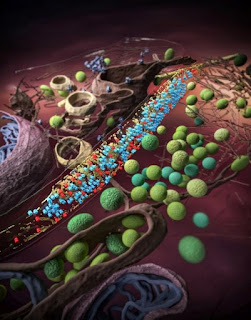
Image credit: Inhibitory Synapse - TAO Changlu, LIU Yuntao, and BI Guoqiang; Image design: WANG Guoyan, MA Yanbing - 2021


Thursday, February 2, 2017

Bad Information

I'm not sure exactly how they got this image, but it sure looks like it came from the Google Deep Dream project where a deep learning network was asked to 'dream' about images and produce 'overpreceived' images, which look a lot like hallucinating on psychoactive mycotoxins.

Is there such a thing as Bad Information? If so, what is the difference between Good and Bad? How do we know that difference?

Artificial intelligence, but information theory in general, is a common theme in Hidden Scents. How can you not write about it these days? We are computers. At least, we are becoming computers. Or they us. At least, that's what say the analogies we use to make sense of our world. Do we know anything aside from the analogies we use? (We should probably be asking Douglas Hofstader about that one)

Back when pneumatics was the technology du jour, we thought the nervous system worked according to pressure in the nerves. That was correct for the circulatory system, but the utility of that analogy ended there. Eventually, the computer analogy will run out, but until then, we are computers. And these days, specifically we are computers learning to recognize patterns in our environment using forward-feebacked layers of feature detection.

This brings us to the premier of a new infotech textbook.

“The Deep Learning textbook is a resource intended to help students and practitioners enter the field of machine learning in general and deep learning in particular.”

Deep Learning, An MIT Press book
Ian Goodfellow and Yoshua Bengio and Aaron Courville, 2016

It's a textbook, so it's too technical for the interested layperson. But there is some goo dintroductory materials that could help straighten things out for people who want to know what it is, but don't have the contect-specific knowledge to digest the whole thing.


Here's from the chapter on Information Theory:

“Likely events should have low information content, and in the extreme case, events that are guaranteed to happen should have no information content whatsoever.

“Less likely events should have higher information content.

“Independent events should have additive information. For example, finding out that a tossed coin has come up as heads twice should convey twice as much information as finding out that a tossed coin has come up as heads once. “

The text then goes on to translate these maxims into mathematical formulae.


Sometimes someone says something and I'm like, wow, that was really stupid. But then later on, when I try to think about -why- it was stupid, I find it difficult to articulate. Above we have a good rationale for explaining why a particular statement is 'stupid' or not. It depends on how much information it has. And this is how we measure that information. In laymen's terms, we would call this the Captain Obvious principle. If you just said something that everyone already knows or should expect, but you said it like it's got good information value (as if nobody knows or expects it) then that would come across as stupid.

There we go again, turning a branch of applied mathematics into a magnifying glass for human behavior; probably not what the authors of this text intended to be done with their work.

Anyway, I like the word hard-coding. They use it to describe the 'older' way of writing-in knowledge about the world into a program (instead of 'letting the program figure it out for itself,' as these newer deep learning programs are done).

They point out in the introduction that "A person's everyday life requires an immense amount of knowledge about the world. Much of this knowledge is subjective and intuitive, and therefore difficult to articulate in a formal way. Computers need to capture this same knowledge in order to behave in an intelligent way. One of the key challenges in artificial intelligence is how to get this informal knowledge into a computer." Instead, when computers get their own data, by extracting patterns from raw data, this is known as machine learning. Deep learning is a type of machine learning.

Still, figuring out which details are valuable and which are inconsequential is the hardest part. -Disentangling- is a word emphasized by the authors. That's a favorite word in Hidden Scents as well. So is inextricable, the information-opposite of disentangle. So is disambiguate, the big brother of disentangle.

If you're into this stuff, and a bit more on the application side than the theoretical side, you might want to check this book out. And if you're just into machine-generated hallucinations, or if you've ever tripped on psilocybic mushrooms and want to see something reminiscent - very reminiscent - unnervingly reminiscent - check out the front cover.


notes:
Analogy as the Core of Cognition, Douglas Hofstadter, Stanford lecture, 2006

Monday, January 23, 2017

Bad Information vs Good Information

Deep Learning, An MIT Press book by Ian Goodfellow, Yoshua Bengio, Aaron Courville, 2016

I'm not sure exactly how they got this image, but it sure looks like it came from the Google Deep Dream project where a deep learning network was asked to 'dream' about images and produce 'overpreceived' images, which look a lot like hallucinating on psychoactive mycotoxins.

Is there such a thing as Bad Information? If so, what is the difference between Good and Bad? How do we know that difference?

Artificial intelligence, but information theory in general, is a common theme in Hidden Scents. How can you not write about it these days? We are computers. At least, we are becoming computers. Or they us. At least, that's what they say. Do we know anything aside from the analogies we use? (We should probably be asking Douglas Hofstader about that one)

Back when pneumatics was the technology du jour, we thought the nervous system worked according to pressure in the nerve fibers. That was correct for the circulatory system, but the utility of that analogy ended there. Eventually, the computer analogy will run out, but until then, we are computers. And these days, specifically we are computers learning to recognize patterns in our environment using forward-feebacked layers of feature detection.

This brings us to the premier of a new infotech textbook.

“The Deep Learning textbook is a resource intended to help students and practitioners enter the field of machine learning in general and deep learning in particular.”

Deep Learning is a (new) textbook, so it's too technical for the interested layperson. But there is some good introductory materials that could help straighten things out for people who want to know what it is, but don't have the context-specific knowledge to digest the whole thing.

Here's from the chapter on Information Theory

“Likely events should have low information content, and in the extreme case, events that are guaranteed to happen should have no information content whatsoever.

“Less likely events should have higher information content.

“Independent events should have additive information. For example, finding out that a tossed coin has come up as heads twice should convey twice as much information as finding out that a tossed coin has come up as heads once. “

The text then goes on to translate these maxims into mathematical formulae.

***
Sometimes someone says something and I'm like, wow, that was really stupid. But then later on, when I try to think about why it was stupid, I find it difficult to articulate. In the text quoted above, we have a good rationale for explaining why a particular statement is 'stupid' or not: It depends on how much information it has. And this is how we measure that information.

In laymen's terms, we would call this the Captain Obvious principle. If you just said something that everyone already knows or should expect, but you said it like it's got good information value (as if nobody knows or expects it) then that would come across as stupid.

There we go again, turning a branch of applied mathematics into a magnifying glass for human behavior; probably not what the authors of this text intended to be done with their work.

***
Anyway, back to the text. I like their word “hard-coding.” They use it to describe the 'older' way of writing-in knowledge about the world into a program (instead of 'letting the program figure it out for itself,' as these newer deep learning programs are done).

They point out in the introduction that "A person's everyday life requires an immense amount of knowledge about the world. Much of this knowledge is subjective and intuitive, and therefore difficult to articulate in a formal way. Computers need to capture this same knowledge in order to behave in an intelligent way. One of the key challenges in artificial intelligence is how to get this informal knowledge into a computer." Instead, when computers get their own data, by extracting patterns from raw data, this is known as machine learning. Deep learning is a type of machine learning.

Still, figuring out which details are valuable and which are inconsequential is the hardest part. Disentangling is a word emphasized by the authors. That's a favorite word in Hidden Scents as well. So is inextricable, the information-opposite of disentangle. So is disambiguate, the big brother of disentangle.

If you're into this stuff, and a bit more on the application side than the theoretical side, you might want to check this book out. And if you're just into machine-generated hallucinations, or if you've ever tripped on psilocybin mushrooms and want to see something reminiscent – very reminiscent – unnervingly reminiscent – check out the front cover.


notes:
Analogy as the Core of Cognition, Douglas Hofstadter, Stanford lecture, 2006