Showing posts with label olfaction. Show all posts

Thursday, April 7, 2022

Smells Like News


Too many headlines, too little time.
Image credit: Smell Test, Win McNamee Getty Images, 2010


Smelling Disease
Monell Updates, Feb 2022

Led by Monell chemical ecologist Bruce A. Kimball, PhD, the research team is taking the innovative approach of classifying fever-inducing diseases based on their distinctive signatures of volatile compounds in urine and saliva.

via the Monell Chemical Senses Center: Millet P., Martin, T., Opiekun, M., Beauchamp, G.K., and Kimball, B.A. (2021). Differing Alterations of Odor Volatiles among Pathogenic Stimuli. Chem. Senses. 46: bjab030.


'E-nose' could someday diagnose Parkinson's disease by 'smelling' skin
Feb 2022, phys.org
Three odor compounds (octanal, hexyl acetate and perillic aldehyde) were significantly different between the two groups, which they used to build a model for PD diagnosis.

Next, the researchers analyzed sebum from an additional 12 PD patients and 12 healthy controls, finding that the model had an accuracy of 70.8% in predicting PD. The model was 91.7% sensitive in identifying true PD patients, but its specificity was only 50%, indicating a high rate of false positives.

Sorry to say but those might not be false positives...we've seen this before (they haven't been diagnosed yet).

via Department of Biomedical Engineering, Zhejiang University, Hangzhou: Wei Fu et al, Artificial Intelligent Olfactory System for the Diagnosis of Parkinson's Disease, ACS Omega (2022). DOI: 10.1021/acsomega.1c05060


Study identifies brain areas that support social semantic accumulation
Feb 2021, phys.org

Olfaction is a social sense, and more reasons why we're bad at naming smells, because as somewhat social words, we think of them in sentences not in words...

via CAS Key Laboratory of Behavioral Science in China and University of Trento in Italy: The brain network in support of social semantic accumulation. Social Cognitive and Affective Neuroscience(2021). DOI: 10.1093/scan/nsab003.


Odd smell: Flies sniff ammonia in a way new to science
Jun 2021, phys.org

They probed all three types of scent neurons in the flies' sensilla, but they didn't respond to ammonia. But the fly was obviously smelling it, based on its behavior. So the researchers realized there had to be a fourth scent neuron they hadn't known was there. And they found it—but it didn't seem to have the usual odor receptors on it. It was covered in ammonia transporter (Amt), a molecule that is known to allow ammonia in and out of cells.

No one had ever known a transporter molecule to also act as an odor receptor. But there it was. When they selectively killed off only that type of neuron, the flies did not respond to ammonia at all. And when the team forced scent neurons that don't normally respond to ammonia to express Amt on their surfaces, those neurons began responding to ammonia, too.

via University of Connecticut: Alina Vulpe et al, An ammonium transporter is a non-canonical olfactory receptor for ammonia, Current Biology (2021). DOI: 10.1016/j.cub.2021.05.025


Scientists on the scent of flavor enhancement
Jul 2021, phys.org

On smelling -- The less they knew about the reference aroma, the higher their chances of correctly identifying a match—a finding that suggests aroma detection involves learning, memory and cognitive strategy.

via The Ohio State University: Mackenzie E. Hannum et al, Non-food odors and the duality of smell: Impact of odorant delivery pathway and labeling convention on olfactory perception, Physiology & Behavior (2021). DOI: 10.1016/j.physbeh.2021.113480
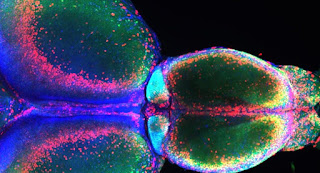
Image credit: Zebrafish Brains - Stephanie Fore - 2021


Smells and emotions tug on the brain's habenula, or 'little rein'
Aug 2021, phys.org

Situational awareness:
Kavli Institute researchers showed that the habenula relays information from the outside world, such as smell and sight, along with internal states associated with emotions and learning, to the brain regions that control adaptive behaviors.

"It turns out that the habenula is an information hub," said Emre Yaksi, a professor at NTNU's Kavli Institute for Systems Neuroscience and head of the research group that did the study. "It integrates information about odors from the environment with the information from the limbic system, which is involved in emotional behaviors and learning."

"We argue that the habenula helps the brain to stop certain actions and communications across brain regions, in order to shift it to another mode that is better suited to the situation that the scent warns of," he said. 

via Norwegian University of Science and Technology: Ewelina Magdalena Bartoszek et al, Ongoing habenular activity is driven by forebrain networks and modulated by olfactory stimuli, Current Biology (2021). DOI: 10.1016/j.cub.2021.08.021


Your sense of smell may be the key to a balanced diet
Aug 2021, phys.org

Long story short -- if you just ate a cinnamon bun, you're less likely to want a cinnamon bun, because something about your olfactory acclimation, adaptation, attenuation... 

via Northwestern University: Laura K. Shanahan et al, Olfactory perceptual decision-making is biased by motivational state, PLOS Biology (2021). DOI: 10.1371/journal.pbio.3001374


New research 'sniffs out' how associative memories are formed
Sep 2021, phys.org

Neuroscientists at the University of California, Irvine have discovered specific types of neurons within the memory center of the brain that are responsible for acquiring new associative memories. Additionally, they have discovered how these associative memory neurons are controlled. 

Specific cells in the lateral entorhinal cortex of the medial temporal lobe, called fan cells, are required for the acquisition of new associative memories and these cells are controlled by dopamine, a brain chemical known to be involved in our experience of pleasure or reward.

In the study, researchers used electrophysiological recordings and optogenetics to record and control activity from fan cells in mice as they learn to associate specific odors with rewards. This approach led researchers to discover that fan cells compute and represent the association of the two new unrelated items (odor and reward). Without these cells, pre-learned associations can be retrieved, but the new associations cannot be acquired. Additionally acquiring new associations also requires dopamine.

"We never expected that dopamine is involved in the memory circuit. However, when the evidence accumulated, it gradually became clear that dopamine is involved," said Igarashi. "These experiments were like a detective story for us, and we are excited about the results."

via University of California, Irvine: Lee, J.Y. et al. Dopamine facilitates associative memory encoding in the entorhinal cortex. Nature (2021). doi.org/10.1038/s41586-021-03948-8


A universal law of physiology emerges from a professor's research
Oct 2021, phys.org

"Imagine you walk into a room someone has just painted. You'll likely think, 'This smells bad.' But the sensation decreases as you stay in there. The molecules don't disappear, not within that time frame. You've just gotten used to it."
-University of Toronto Engineering professor Willy Wong 

From an initial state, the organism's response activity rises to a peak response, then falls to a new final steady state. Wong has discovered that those three fixed points on the adaptation curve form a mathematical relationship that is obeyed across all sensory modalities and organisms.

"I compared 250 measurements of adaptation from different branches of sensory physiology and found that they are all compatible with a single, simple equation," says Wong.

via University of Toronto: Willy Wong, Consilience in the Peripheral Sensory Adaptation Response, Frontiers in Human Neuroscience (2021). DOI: 10.3389/fnhum.2021.727551


Scent of newborn infants blocks aggression in men, stimulates aggression in women
Nov 2021, phys.org

Dr. Eva Mishor from Prof. Noam Sobel's research group at Weizmann's Brain Sciences Department and the Azrieli Institute for Human Brain Imaging and Research have found that a molecule that can likely be sensed by all mammals, and that is found in abundance on the scalps of newborns, sparks brain and behavioral changes in adults who are exposed to it, affecting women one way, and having the opposite effect on men.

The finding is among the first to provide a direct link between human behavior and a single molecule picked up through the sense of smell. Furthermore, the diametrically opposed change it effected in women and men sheds new and surprising light on the mediating role sex plays in olfactory perception and its resulting neurological processes.

They're talking about pheromones, which as far as we know, do not work in humans. Apparently that has changed now?

The odor is hexadecanal, or HEX, and although you can't smell it, if you sniff it, it will affect your behavior. We already know it affects mice, but humans not so much. Not until now that is. We also know, through less-scientific means, that the only universally-liked smell for all people everywhere is the baby's head. 

via Weizmann Institute of Science: Eva Mishor et al, Sniffing the human body volatile hexadecanal blocks aggression in men but triggers aggression in women, Science Advances (2021). DOI: 10.1126/sciadv.abg1530

Tuesday, October 17, 2017

Mutation in Media Res

Alex Grey

Neanderthals didn't give us red hair but they certainly changed the way we sleep
Oct 2017, phys.org

Just thinking here about the intersection of genes and culture and their effects on our olfactory world.

This article mentions that one of the differences between people with lots of Neanderthal genes (Caucasians and to a lesser extent Asians) and people without so many Neanderthal genes (Africans) is that the Africans have a distaste for pork. I'm not an expert here, please note. But I do recall a variation on a gene that codes for pork, making male boar taste like piss to some folks but sweet to others. There's another one, not related to cavemen (as far as I know), that makes cilantro taste like soap to some people and yet a delicious herb to others.

The fact that these examples even appear in the news is because taste is far more conspicuous than smell (despite the fact that most of what we taste is actually smell). But these examples of varying genes for coding sensory perception are at least a good reminder of the fact that our sense of smell is proof that we are still evolving.

Two percent of our genome is devoted to smell - of our 10,000 genes, 250 are for smelling. The way genes work is complex, and simple arithmetic is no way to measure it, and 2% might not even sound like a lot, but still - these 250 smelling-genes are the largest of all the gene families. What's more, many of these genes have variations, called alleles, like hair varying from black to brown to red to blonde. That means the way something smells to you may differ from that of other people.

While listening to a talk on this stuff given by a smell Nobel, Richard Axel, I discovered that the gene, or genes, that code for some of the aroma compounds in broccoli have variations. That means some people taste the bad part of broccoli more than others, or that some people taste the good part more than others. Bottom line is that broccoli is not the same for everyone. And this goes for lots of things.

As far as we know, there is no allele on the genes that we use for vision. We have three photoreceptors, controlled by 3 genes (again I'm not an expert, maybe it's more complicated than this). We agree on colors, which is to say that we all see the same colors in the same way. This means that we are done evolving in regards to color (yes?). But when you see this many [olfactory] mutations occuring throughout the population, well, it means that we are still in the process of evolving. We aren't growing extra toes, or losing tails, but we are still going through the process.

Back in the day, part of this process involved a Homo Sapien seducing a Neanderthal, and making mutant cross-species babies. Before that, it meant walking on the ground instead of swinging in the trees. Today, I think we would have no idea what is really steering our species in one direction or another, but the fact that we all have such a variety of different smelling-genomes is proof that it's still happening. 

notes:

Scents and Sensibility: Representations of the Olfactory World in the Brain
Richard Axel, Columbia University, 2015


Related Links:

Human Evolution in Action


From Network Address:

Milk Does a Body, 2017

FurFuryl Mercapton, Abstract Foods, and Flavor Networks, 2012

Seeing Red, 2013
 

Sunday, August 13, 2017

Ask Alexandra Horowitz


Alexandra Horowitz is a teacher of psychology, animal behavior, and canine cognition at Barnard College, Columbia University, in New York City. She is also author of Being a Dog: Following the Dog Into a World of Smell. Her book is as much about human olfactory cognition as it is about dogs, and her easily accessible narrative offers a heck of a lot of information about the sense we’re all missing.

The book was great, and I am definitely not looking the same at dogs, and their walkers, after reading it. I posted a bunch of notes here. Still, I was compelled to ask her if she might give some time to answer a few questions for the blog here, and what do you know, she found a moment on her summer break to get back to us.  

***
AB: 1. The thing I am perhaps most fascinated with when it comes to smell is its ability to tell us things that are otherwise invisible, and at times these things can be very personal information about people.

I have heard from a friend of mine, who is really sensitive to smells, she's an eye doctor, and she says she can tell if one of her patients are cheating on their spouses (still awaiting the details of how the heck she knows that).

Do you find it uncomfortable at times to 'learn' something about someone that you shouldn't know?

AH: I don't know that I have the olfactory acuity of your doctor friend! I have definitely startled my students by knowing who had garlic with yesterday's dinner, or -- not so uncommon -- who's just had a cigarette. I think that they feel uncomfortable with someone having that knowledge, but I don't. Now, if I had a nose with the sensitivity of dogs' noses, maybe I would be gleaning information that I'd rather not have. But one can also simply not sniff....

(I would have to playfully disagree here, as I had to remind myself recently in a somewhat uncomfortable social situation – you can close your eyes, you can put the earbuds in your ears, but you can’t not smell, unless you want to not breathe.)


2. Is there any particular source you recommend for more information on astronauts and smell?

Look at the work that NASA has done to impart flavor to foods. (Also, if you run across an astronaut, ask him! That's what I did...)

(Well I guess I should ask an astronaut because all I get is this - For astronauts, there's little gravity, and this changes the pressure in your head and your sinuses, so that it's hard to breathe through your nose, which means you can't smell - and that means your food doesn't taste like anything. But that's only for the first few days; our bodies get used to it. So why does food continue to taste different? Scientists can't say for sure. For example, it could be that the confined space of the station, crowded with all the other smells of other bodies and machines etc., make a very noisy environment for our noses, and so the food is drowned out. And bland food means more spicy flavors, more Tabasco sauce.) 


3. [This is a reference to Horowitz’ recounting of the trick where a person is asked to choose a book from a shelf, hold it and thumb through the pages, then put it back. The ‘magician’ then enters the room, and recovers the chosen book; “You just smell the books,” Feynman said.] Have you ever pulled the Feynman trick as part of an informal investigation in a public place?

No! Although now that you mention it, I will try it forthwith. I have pulled out le Nez du Vin - small bottles with odors present in wines - with many visitors, and we try to guess the smell source. It's fascinating, as inevitably there will be one person who is surprisingly good at naming the odors, while the rest of us grasp at straws.

(Besides Le Nez du Vin, there's also Le Nez du Cafe, and Le Nez du Whisky. And as I happen to be looking at the World Coffee Research Sensory Lexicon, I see that there are simple ways to make on your own samples - for a papery aroma, boil a coffee filter in water and smell the water; for a 'fermented' note, get some grass and let it ferment in a jar for two weeks. Still, it’s a lot easier to carry a bottle of essential oil in your bag than a jar of fermenting vegetables.)


4. And finally, will we ever have smelling robots?

There are lots of people who are banking on it. DoD and others have funded a lot of research on developing artificial noses -- so far without surpassing a dog nose. In fact, a lot of the fascinating detail I discovered about the airflow in a dog's nose came from a Penn State group that was looking to use that information in the design of an artificial nose.

Still, no one yet knows what combination of factors (in the nose and the brain, in anatomy and behavior) leads to macrosomatic animals being so good at smelling. We will have artificial noses, but they won't soon improve upon the many very good biological ones, I'd predict.

(Artificial noses are usually designed to detect specific odors, like explosives or drugs. So to call them artifical noses needs some explaining. It's like designing an eye that can only see bright green, and then calling it an artificial eye. Not to discredit the work of artificial noses, just disambiguation. If the program she is speaking of here is DARPA's RealNose, it has since been cancelled. There have been plenty of other attempts, and some successful, to make these "single-serving robot noses," but my favorite - remote control bomb sniffing locusts!)

***
And so there you have it. Smelling robots are far, far away. About as far as getting a good taylor ham egg and cheese sandwich in outer space.

Much thanks to Alexandra Horowitz for taking the time to give some food for thought, beyond the wealth of information that is already presented in her book.

For more material by Alexandra Horowitz, here’s a talk on NPR, and a video from the University of California TV.