Showing posts with label smell news. Show all posts

Thursday, October 13, 2022

Headlines in the Smell World


Scientists thought they knew how the nose 'knows,' but new research suggests otherwise
Aug 2022, phys.org

I'm not doing a great job following this development, a reversal rather -- there's apparently some reconsideration that needs to be given to the way odorous molecules activate their respective olfactory receptors. Smell is the most understudied of all our senses, so it should be less of a surprise that one of the foundationary hypotheses of olfactory science needs some fine-tuning: 

G protein signal amplification is actually very low—so low that the probability of an odorant receptor activating just one G protein would be perhaps only 1 in 10,000. Yau said that, as such, the activation level "is very weak."

On a sidenote, what really stands out to me from this article is that the rhodopsin in the photosensitive cells on your retina (and all over your body in fact) are so sensitive they can detect a single photon of light. One single photon. And I thought our nose was sensitive. (It is, but for chemicals; the eye, and the photoreceptors in it, are for detecting the electromagnetic radiation beaming through our solar system.)

via Johns Hopkins University School of Medicine: Rong-Chang Li et al, Low signaling efficiency from receptor to effector in olfactory transduction: A quantified ligand-triggered GPCR pathway, Proceedings of the National Academy of Sciences (2022). DOI: 10.1073/pnas.2121225119


Friends at first sniff: People drawn to others who smell like them
Jun 2022, phys.org

The researchers found that the odor signatures of "click friends" were statistically more closely matched than odors between non-friends.
This study was done using the T-shirt test, an old trusty in smell science. 

I can't figure out which is more interesting here. The word "click friends" is pretty cool, never heard it. But this one is good: "Nonhuman terrestrial mammals constantly sniff themselves and each other and, based on this, decide who is friend or foe," wrote a group of researchers led by Inbal Ravreby at Weizmann Institute of Science in Israel.

"I don't sniff myself; I am not an animal; gross" as you completely obliviously brush your hair away from your face, or scratch your temple. The study that proved our absolute inability to avoid smelling our own hands (and the hands of everyone we meet, by way of our own hands that shook theirs) found that BEFORE the study even started, while people were still in the waiting room, they had their hand ready next to their nose 22% of the time! (see older post and the article itself). Filthy animals!

via Weizmann Institute of Science in Israel: Inbal Ravreby et al, There is chemistry in social chemistry, Science Advances (2022). DOI: 10.1126/sciadv.abn0154


People who consider olfaction important and actively sniff other's odors have stronger sexual desire
Aug 2022, phys.org

This study is based on questionnaires given to Chinese college students, and recall that there is a general understanding in the smell world that Asian people tend to not have the same scent-emitting glands as non-Asians; in other words, the deodorant market doesn't work very well in China. After their initial findings however, they started over and sent the same questionnaires to college students in both the U.S. and in India, and after all that:

  • Students who reported giving high value to olfaction or who actively sniffed other people also reported having a stronger sexual desire than others who responded.
  • Women tended to place more emphasis on smell than men, and reported lower levels of sexual desire in general.
  • Men in India reported stronger sexual desire than those in China and the U.S., and they also reported placing more importance on olfaction.  

A final thought -- culture in some ways can be a stronger mediator for olfactory perception than biology or genetics. Science like this is great, but it's only s very small piece of the full picture. I'm thinking of how the Marshmallow Test fell apart in a recent study because they considered that Japanese kids are conditioned to wait for everyone to be ready to eat at the dinnertable, and U.S. kids are not. 

via Southern Medical University in China and Technische Universität Dresden in Germany: Zi-lin Li et al, Sniffing of Body Odors and Individual Significance of Olfaction Are Associated with Sexual Desire: A Cross-Cultural Study in China, India, and the USA, Archives of Sexual Behavior (2022). DOI: 10.1007/s10508-022-02398-1


Rapid loss of smell predicts dementia and smaller brain areas linked to Alzheimer's
Jul 2022, phys.org
 
(But how about their sexual desire??)

via University of Chicago Medicine: Rapid olfactory decline during aging predicts dementia and GMV loss in AD brain regions, Alzheimer s & Dementia (2022). DOI: 10.1002/alz.12717


New study reveals where memory fragments are stored
Jul 2022, phys.org

This is about memory recall, the way we access memories stored in our brains, and it certainly does change the olfactory science, since we tend to consider olfaction as being deeply connected to our autobiographical memory via the hippocampus, which it is, but this suggests there are more olfactory details being stored in the prefrontal cortex than we thought:

While the overall experience is stored in the hippocampus, the brain structure long considered the seat of memory, the individual details are parsed and stored elsewhere, in the prefrontal cortex. This separation ensures that, in the future, exposure to any individual cue is sufficient to activate the prefrontal cortex, which then accesses the hippocampus for recall of the whole memory.

via Laboratory of Neural Dynamics and Cognition at Rockefeller University and Weill Cornell Medicine: Priyamvada Rajasethupathy, Prefrontal feature representations drive memory recall, Nature (2022). DOI: 10.1038/s41586-022-04936-2

Thursday, April 7, 2022

Smells Like News


Too many headlines, too little time.
Image credit: Smell Test, Win McNamee Getty Images, 2010


Smelling Disease
Monell Updates, Feb 2022

Led by Monell chemical ecologist Bruce A. Kimball, PhD, the research team is taking the innovative approach of classifying fever-inducing diseases based on their distinctive signatures of volatile compounds in urine and saliva.

via the Monell Chemical Senses Center: Millet P., Martin, T., Opiekun, M., Beauchamp, G.K., and Kimball, B.A. (2021). Differing Alterations of Odor Volatiles among Pathogenic Stimuli. Chem. Senses. 46: bjab030.


'E-nose' could someday diagnose Parkinson's disease by 'smelling' skin
Feb 2022, phys.org
Three odor compounds (octanal, hexyl acetate and perillic aldehyde) were significantly different between the two groups, which they used to build a model for PD diagnosis.

Next, the researchers analyzed sebum from an additional 12 PD patients and 12 healthy controls, finding that the model had an accuracy of 70.8% in predicting PD. The model was 91.7% sensitive in identifying true PD patients, but its specificity was only 50%, indicating a high rate of false positives.

Sorry to say but those might not be false positives...we've seen this before (they haven't been diagnosed yet).

via Department of Biomedical Engineering, Zhejiang University, Hangzhou: Wei Fu et al, Artificial Intelligent Olfactory System for the Diagnosis of Parkinson's Disease, ACS Omega (2022). DOI: 10.1021/acsomega.1c05060


Study identifies brain areas that support social semantic accumulation
Feb 2021, phys.org

Olfaction is a social sense, and more reasons why we're bad at naming smells, because as somewhat social words, we think of them in sentences not in words...

via CAS Key Laboratory of Behavioral Science in China and University of Trento in Italy: The brain network in support of social semantic accumulation. Social Cognitive and Affective Neuroscience(2021). DOI: 10.1093/scan/nsab003.


Odd smell: Flies sniff ammonia in a way new to science
Jun 2021, phys.org

They probed all three types of scent neurons in the flies' sensilla, but they didn't respond to ammonia. But the fly was obviously smelling it, based on its behavior. So the researchers realized there had to be a fourth scent neuron they hadn't known was there. And they found it—but it didn't seem to have the usual odor receptors on it. It was covered in ammonia transporter (Amt), a molecule that is known to allow ammonia in and out of cells.

No one had ever known a transporter molecule to also act as an odor receptor. But there it was. When they selectively killed off only that type of neuron, the flies did not respond to ammonia at all. And when the team forced scent neurons that don't normally respond to ammonia to express Amt on their surfaces, those neurons began responding to ammonia, too.

via University of Connecticut: Alina Vulpe et al, An ammonium transporter is a non-canonical olfactory receptor for ammonia, Current Biology (2021). DOI: 10.1016/j.cub.2021.05.025


Scientists on the scent of flavor enhancement
Jul 2021, phys.org

On smelling -- The less they knew about the reference aroma, the higher their chances of correctly identifying a match—a finding that suggests aroma detection involves learning, memory and cognitive strategy.

via The Ohio State University: Mackenzie E. Hannum et al, Non-food odors and the duality of smell: Impact of odorant delivery pathway and labeling convention on olfactory perception, Physiology & Behavior (2021). DOI: 10.1016/j.physbeh.2021.113480

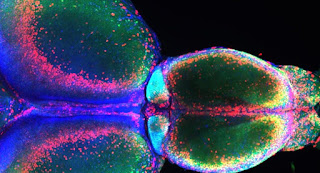
Image credit: Zebrafish Brains - Stephanie Fore - 2021


Smells and emotions tug on the brain's habenula, or 'little rein'
Aug 2021, phys.org

Situational awareness:
Kavli Institute researchers showed that the habenula relays information from the outside world, such as smell and sight, along with internal states associated with emotions and learning, to the brain regions that control adaptive behaviors.

"It turns out that the habenula is an information hub," said Emre Yaksi, a professor at NTNU's Kavli Institute for Systems Neuroscience and head of the research group that did the study. "It integrates information about odors from the environment with the information from the limbic system, which is involved in emotional behaviors and learning."

"We argue that the habenula helps the brain to stop certain actions and communications across brain regions, in order to shift it to another mode that is better suited to the situation that the scent warns of," he said. 

via Norwegian University of Science and Technology: Ewelina Magdalena Bartoszek et al, Ongoing habenular activity is driven by forebrain networks and modulated by olfactory stimuli, Current Biology (2021). DOI: 10.1016/j.cub.2021.08.021


Your sense of smell may be the key to a balanced diet
Aug 2021, phys.org

Long story short -- if you just ate a cinnamon bun, you're less likely to want a cinnamon bun, because something about your olfactory acclimation, adaptation, attenuation... 

via Northwestern University: Laura K. Shanahan et al, Olfactory perceptual decision-making is biased by motivational state, PLOS Biology (2021). DOI: 10.1371/journal.pbio.3001374


New research 'sniffs out' how associative memories are formed
Sep 2021, phys.org

Neuroscientists at the University of California, Irvine have discovered specific types of neurons within the memory center of the brain that are responsible for acquiring new associative memories. Additionally, they have discovered how these associative memory neurons are controlled. 

Specific cells in the lateral entorhinal cortex of the medial temporal lobe, called fan cells, are required for the acquisition of new associative memories and these cells are controlled by dopamine, a brain chemical known to be involved in our experience of pleasure or reward.

In the study, researchers used electrophysiological recordings and optogenetics to record and control activity from fan cells in mice as they learn to associate specific odors with rewards. This approach led researchers to discover that fan cells compute and represent the association of the two new unrelated items (odor and reward). Without these cells, pre-learned associations can be retrieved, but the new associations cannot be acquired. Additionally acquiring new associations also requires dopamine.

"We never expected that dopamine is involved in the memory circuit. However, when the evidence accumulated, it gradually became clear that dopamine is involved," said Igarashi. "These experiments were like a detective story for us, and we are excited about the results."

via University of California, Irvine: Lee, J.Y. et al. Dopamine facilitates associative memory encoding in the entorhinal cortex. Nature (2021). doi.org/10.1038/s41586-021-03948-8


A universal law of physiology emerges from a professor's research
Oct 2021, phys.org

"Imagine you walk into a room someone has just painted. You'll likely think, 'This smells bad.' But the sensation decreases as you stay in there. The molecules don't disappear, not within that time frame. You've just gotten used to it."
-University of Toronto Engineering professor Willy Wong 

From an initial state, the organism's response activity rises to a peak response, then falls to a new final steady state. Wong has discovered that those three fixed points on the adaptation curve form a mathematical relationship that is obeyed across all sensory modalities and organisms.

"I compared 250 measurements of adaptation from different branches of sensory physiology and found that they are all compatible with a single, simple equation," says Wong.

via University of Toronto: Willy Wong, Consilience in the Peripheral Sensory Adaptation Response, Frontiers in Human Neuroscience (2021). DOI: 10.3389/fnhum.2021.727551


Scent of newborn infants blocks aggression in men, stimulates aggression in women
Nov 2021, phys.org

Dr. Eva Mishor from Prof. Noam Sobel's research group at Weizmann's Brain Sciences Department and the Azrieli Institute for Human Brain Imaging and Research have found that a molecule that can likely be sensed by all mammals, and that is found in abundance on the scalps of newborns, sparks brain and behavioral changes in adults who are exposed to it, affecting women one way, and having the opposite effect on men.

The finding is among the first to provide a direct link between human behavior and a single molecule picked up through the sense of smell. Furthermore, the diametrically opposed change it effected in women and men sheds new and surprising light on the mediating role sex plays in olfactory perception and its resulting neurological processes.

They're talking about pheromones, which as far as we know, do not work in humans. Apparently that has changed now?

The odor is hexadecanal, or HEX, and although you can't smell it, if you sniff it, it will affect your behavior. We already know it affects mice, but humans not so much. Not until now that is. We also know, through less-scientific means, that the only universally-liked smell for all people everywhere is the baby's head. 

via Weizmann Institute of Science: Eva Mishor et al, Sniffing the human body volatile hexadecanal blocks aggression in men but triggers aggression in women, Science Advances (2021). DOI: 10.1126/sciadv.abg1530