Tuesday, January 10, 2017

Evolvable Chemical Systems

Mitochondrion with endoplasmic reticulum, Center for Molecular Microscopy

Chemists create 'artificial chemical evolution' for the first time

“[The team from the University of Glasgow's School of Chemistry led by Professor Lee Cronin] created an evolving chemical system using a robotic 'aid' and could be used in the future to 'evolve' new chemicals capable of performing specific tasks.

“A robot monitors and selects for further development droplets of different chemical compounds, mimicking natural selection to produce 'fit' compounds.”

It is an attempt to produce new chemical life forms.

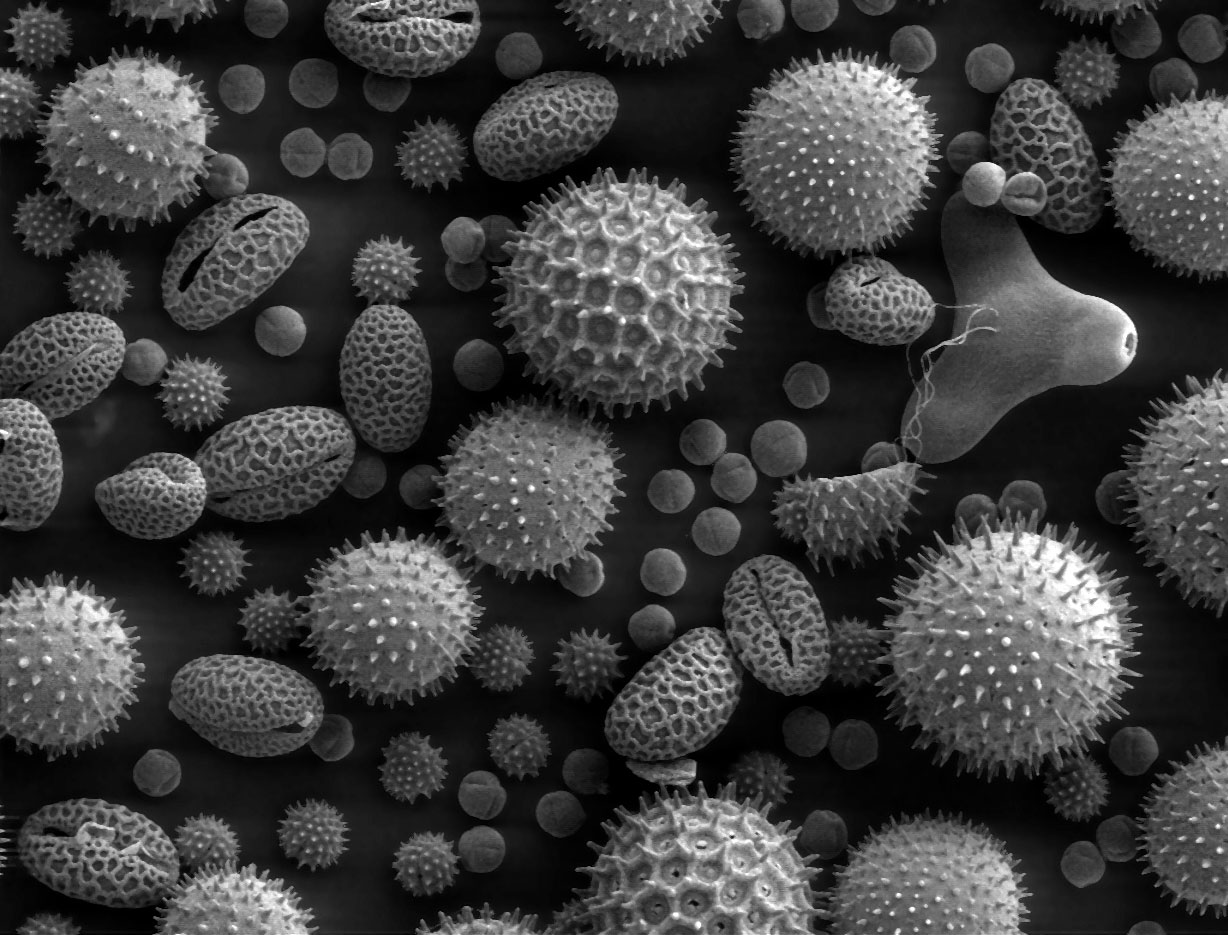
microscopy, pollen

The matter compiler in Neal Stephenson’s Diamond Age makes things molecule-by-molecule. It is fed by huge lines of individual atoms. They use it to make things like clothes and cutlery. The process described above is instead used to discover new chemicals combinations. In the world of perfumery, for example, this could be very helpful.

I also can’t help but mention, at the very end of the article, we hear about inorganic-chemical cells “built from molecules of metal and exhibit some of the same abilities as living cells.” Will killer robots smell fear, that’s all I want to know.

Friday, January 6, 2017

Bacteria, Molecules, and Other Small Things That Sense and Remember


Here I’ve compiled some articles from my notebook that look at how our senses work when it comes to simpler forms of life, like bacteria. There’s even something about how molecules – very far from what we consider ‘living things’ – uses a form of memory. All this has been put together to reinforce an idea presented in Hidden Scents which suggests that our awe-inspiring brain is similar to things less inspiring, like the lowly eukaryote.

Some of these things are really old, and most of the text here is copied from the links provided. Overall I hope it’s interesting enough to keep your attention:

***

“…there is a distinction between an organism reacting to a chemical that it encounters directly (in analogy to the sense of taste) and a reaction to a chemical that is floating around in the air, says Reindert Nijland, lead author of the study.

"The compounds detected by olfactory organs are generally much more volatile than things you can taste like 'sweet' or 'salt', and therefore can provide information about things that can be much further away; you can smell a barbecue from a few blocks away whereas you have to physically touch and eat the steak to be able to actually taste it."

***
phys.org, Feb 2016

“ "Very little is known about the microbes of the built environment," microbiologist Maria Gloria Dominguez-Bello of New York University, who led the pilot study, said at a meeting of the American Association for the Advancement of Science.


“Her team found that as people living in the Amazon rainforest become more urbanized, the kinds of bacteria in their homes change from the bugs mostly found in nature to those that typically live on people, she reported Friday.

In fact, in city dwellings, the researchers could tell just by the microbial fingerprints of the walls that "this is a kitchen or this is a bathroom or this is a living room. That's amazing," Dominguez-Bello said.

“Despite fewer occupants, the more urbanized a dwelling, the more human bacteria lived on its walls and floors, the researchers reported in the journal Science Advances. In Manaus, a collection of microbes normally found in the mouth, including various species of strep bacteria, and in the gut were the most important in telling rooms apart. The more crowded jungle and rural homes nonetheless were filled with more bacteria commonly found in soil and water than with human microbes.”

The microbiome has become a big deal lately. As much as it is invisible, it’s not unrecognizable.

Its kind of funny how, first, we didn’t know what microorganisms were one hundred years ago, and are only now beginning to understand the role of microbes (in their totality, as the microbiome) in human health, and yet, I would conjecture that the smell of the microbiome, its dynamic states of existence and effects, have been well known to us for quite some time. I cannot see your body odor, even if I look really close. But I know it’s there.

***
phys.org, Feb 2016

This isn’t about smelling, but sensing nonetheless…

“Dmitri A. Nusinow, Ph.D., assistant member at the Danforth Plant Science Center and researchers in his lab studying plants' circadian clock have discovered a gene that allows plants to remember daylight during the long nights of winter, helping them tailor their growth appropriately to the seasons.”

***
BBC, Feb 2016

“After more than three centuries of scientists eyeballing bugs under microscopes, Prof Mullineaux said it was remarkable that nobody had picked up on this before.”

“the entire organism acts like an eyeball”

“Cyanobacteria, including the Synechocystis species used in the study, are an ancient and abundant lifeform. They live in water and get their energy from photosynthesis - which explains their enthusiasm for bright light.”

Can’t resist mentioning that cyanobacteria are what make the ‘smell of the seashore;’ it emanates from their little bacteria bodies as they metabolize, and we can also call it seaweed sweat or seaweed pheromones or seaweed seeking sex.

***
phys.org, Jan 2016

“This device, reported in the Jan. 28 issue of the journal Nature, is the first fully integrated electronic system that can provide continuous, non-invasive monitoring of multiple biochemicals in sweat.

“The advance opens doors to wearable devices that alert users to health problems such as fatigue, dehydration and dangerously high body temperatures.

"Human sweat contains physiologically rich information, thus making it an attractive body fluid for non-invasive wearable sensors."

***
[and on that note...]
phys.org, Feb 2016

"Thousands of bacteria species have the potential to live on human skin, and in particular in the armpit," says Rob Dunn, a professor of applied ecology at NC State and co-author of the paper. "Just which of these species live in any particular armpit has been hard to predict until now, but we've discovered that one of the biggest determinants of the bacteria in your armpits is your use of deodorant and/or antiperspirant."


"We found that, on the first day, people using antiperspirant had fewer microbes in their samples than people who didn't use product at all - but there was a lot of variability, making it hard to draw firm conclusions," Horvath says. "In addition, people who used deodorant actually often had more microbes - on average - than those who didn't use product."

“By the third day, participants who had used antiperspirant were beginning to see more microbial growth. And by day six, the amount of bacteria for all study participants was fairly comparable.

"However, once all participants began using antiperspirant on days seven and eight, we found very few microbes on any of the participants, verifying that these products dramatically reduce microbial growth," Horvath notes.

“The participants who had been regular antiperspirant users coming into the study had wildly different results. Sixty percent of their microbes were Staphylococcaceae, only 14 percent were Corynebacteria, and more than 20 percent were filed under "other" - meaning they were a grab-bag of opportunistic bacteria.

***
[aaaandddd]
phys.org, Nov 2015

“Swarm robotics is an emerging approach to the coordination of multi-robot systems, which takes inspiration from the natural world to examine the possibilities for improved interaction between robots and their surrounding environment.

“Until now, researchers specialising in swarm robotic applications have been unable to replicate all the aspects of pheromone communication that occur in the natural world.


“Specialists from the University of Lincoln's School of Computer Science have now produced a novel artificial pheromone system that is reliable, accurate and only uses 'off-the-shelf' components …[which] allows users to simulate several pheromones and to change their strength.


“Led by Farshad Arvin, PhD researcher in the School of Computer Science, the Lincoln team developed the system using their own Colias platform. They created Colias - an open-platform system that can be used to investigate collective behaviours and be applied to swarm applications - in 2014 in collaboration with experts from Tsinghua University in China.”

Wednesday, January 4, 2017

The Fragrance Industry Speaks


The inquisitive soul will immediately come upon two major entities acting as the gatekeepers of odorant-information. These are the fragrance industry and the scientific discipline of organic chemistry. Each one has its own way of making it very difficult to make sense of the smells around us – but in particular the aroma compounds that combine to make up those smells.

Flavor and fragrance are certainly enmeshed, and so the food industry is very close. Both are organized into only a handful of companies. It is with great power and airtight secrecy that they operate. The discovery of new aroma compounds, and of cheaper methods of replicating known ones, is a critical endeavor for their business. Keeping these discoveries unknown to competitors is even more critical.

In instances where a significant aroma has been synthesized, a trade name is given – but that is all. No other chemical clues are released, as not to inform the competition. In fact, in the case of the synthetic musk Phantolide, the international body of chemical nomenclature had no name for the molecule for years after it was discovered by the fragrance industry. Anecdotally, many of these “discoveries” by the fragrance industry were actually accidents of other pursuits, such as explosives (synthetic musk) and anti-depressants (“marine”/Calone).

Fragrance companies don’t supply the public with information about aroma compounds, but about Fragrance – artfully crafted combinations of aroma compounds. And in the case of masking-fragrances, where the intent is to use a good smell to camouflage a bad smell, the scent is invisible by design, and the public isn’t even supposed to know it exists in the first place, let alone seek information on its molecular components.

And so not only is it in direct opposition to the business model of a fragrance company to divest information about its products’ ingredients, their desire and capacity for discovering new compounds is greater than publicly-funded, publicly-accessible scientific discoveries.*

There is no such thing as a public arts fund for Fragrance, and so there is no knowledge acquired in the process of this craft that can be availed to the public. A passing thought: in comparison to the visual arts and music, smell-as-art is completely “patronized” by private industry.

*The presence of the amateur perfumer community warrants mention on this subject. The online community of basenotes.net is one of the few places one can go to search through conversations about smell from such a diverse and knowledgeable people.


Tuesday, January 3, 2017

Open Up

Image source

can someone figure out how to turn this into an artificial nose pleaes

WIRED, Jan 2016

Wednesday, December 21, 2016

Moss Man and Stinkor - Aromatic Thermoplastics


I wonder how many other middle-aged men are selling their childhood toys on ebay right now. (Actually, I wrote this for my other blog, just about one year ago, and all my toys are now gone, and in their place I got enough money to buy a plane ticket to the Institute for Art and Olfaction in Los Angeles, California.) It certainly has been a trip down Memory Lane, but I find it somewhat embarrassing that I missed these two guys in the process.

Moss Man and Stinkor are action figures from Mattel’s He-Man and the Masters of the Universe line, circa 1985. They stand out because they came with their own smell - Pine-Sol and Patchouli, respectively. According to the interwebs, Mattel actually poured patchouli oil into Stinkor's mold, to hold that baked-in freshness for eternity (or Eternia, as it were).

This time capsule of the olfactory imagination is no match for Strawberry Shortcake, mind you, who's perfumed hair no longer smells like strawberries. (I'm going to speculate here that Moss Man's scent was also added to the furry moss on his body; not as permanent as Stinkor.)

So one would think that to open a box of thirty year-old He-Men I would be transported by this odormobile to a time long forgotten.

As it turns out, the overall nostalgia from all that visual and tactile stimulation overpowered the triggers of Stinkor's scent. I've already sold all my He-Men, and I don't remember smelling a thing.

But the real question, since when is patchouli a stand-in for skunk?

Or, maybe Mattel had some real jokesters on their team.

notes:
John Brownlee, FastCo Design, 2013 June 24

Go to the main He-Man website for more information


Wednesday, December 14, 2016

The Universal Language of Chemosignals

source: What Do Plants Talk About

Not only can plants “see” light and “hear” vibrations, they are now known to smell parasitic worms. These nematodes communicate with each other using pheromones (specifically ascarosides), which in turn regulate the worm’s development and behavior. We might think of it as wi-fi.

The chemical signal is excreted (or transmitted) from one worm, and received by another. Plants, using that natural tendency of all living things to be clever, hack into the nematode wi-fi network, and use that information to regulate their own behavior and development. When you watch roots grow in timelapse, you realize they're just like worms, wiggling through the ground, looking for nutrients. Only they're not looking, they're smelling.

This should be a reminder to us that the thing we call Smell is a primitive form of communication used by all living things. Plants don't have brains, so they don't smell like we do. But they do have memories, and even autobiographies. We would call this ontological history – these are interactions stored in the ever-changing DNA of the plant. Experience is passed on to subsequent generations.

The first organisms lived in a chemical world. And although they may have been sensitive to light particles and waves of vibration, they were also a receiver of chemical signals. And of the lot, the chemo-signals were the most complex and required the most sophisticated translation. Our brains – real human brains – grew through evolution out of the olfactory bulb. We may associate the advanced cortical functions of our mind with other, higher senses like vision and audition, but that whole thing is undergirded by the primitive nose- brain. “We think because we smell.” (Diane Ackerman, A Natural History of the Senses, 1990)

Our impossibly complex brains can't really fathom what it means for a plant to smell until we come to understand our own chemically-encrypted selves.

Chemo-signal pattern recognition has come a long way, and it’s a history worth looking into.


Wednesday, December 7, 2016

Froot Flavored


How Can Froot Loops Be Real If the Flavors Aren’t Real?

It’s true, Froot Loops are all the same flavor.

Back in the early days of the Internet, when people were still learning not to use made-up punctuation on message boards, there was a place where you could go to get information about all those random thoughts you have while lying in bed at night. No, it wasn’t called Google, but a predecessor of infinite internet wisdom – Straight Dope.

Although it was re-discovered in a 2014 Today I Learned thread on Reddit, the furthest back we can go is to the Straight Dope message boards of 1999. Surely, however, people have been getting into fistfights over this for many years prior.

The eye-opening part is that most cereals that come in different colors are probably the same in flavor (Ahem, Fruity Pebbles, yes).

Kellogg’s isn’t trying to be manipulative outright; they don’t even call it fruit (it’s Froot). They’re just playing a game that was started around the time of tri-color vision in primates, and one that we all take part in, and one that we actually choose to play. (If not up until now, then after knowing this, you will be forever complicit in the game. The yellow ones will still get left behind.)

Perception is multimodal, that is to say, we do not “see” or “hear” in isolation. We don’t sense anything as “raw information”; instead we perceive things, and this means that the original sensory stimulus has to be processed in its corresponding cortical areas of the brain. For Smell, the raw stimulus gets laced up into your virtual memory body, via the limbic system, before the cortical areas get a chance at it. Regardless, most sensory experience is a mixture of all the senses.

This makes sense, because it makes things more accurate. The brain likes to check with all available information, and that means all sensory information, before verifying what something is. Vision is usually the best verifier for us, so much that it cognitively overrides other senses like smell and taste. There is a reason why almost everything we eat (in America at least) is artificially-colored. *

Sometimes cognitive override yields false results, and this is especially the case with olfaction. There are tons of studies that support this. But if you ate Froot Loops as a kid, you don’t need science, because chances are you thought the yellow was lemon, the orange orange, and so on.

The flavor of Froot Loops is indeed a mixture of the “flavors” that can be derived from various fruits, just that they’re all mixed together. And what does Kellogg’s call this omni-flavored fruit? “Froot”, of course. Froot Loops are not Fruit flavored, but Froot flavored. **


*In the UK, Froot Loops only comes in three colors (purple, orange, green) because they can’t legally use artificial coloring.

**I only repeat this because I saw it in the reddit thread: The main flavoring is bergamot, which is also the flavor in Earl Gray tea.

And one more, because I thought this was just the best comment of all: You don’t eat froot loops one at a time, so how should you even know?