Friday, August 20, 2021

On Handshakes and Animal Behavior

AKA Olfactory Sampling

Non-human primates Mark Zuckerberg and Pope Francis shaking hands and about to smell each other's chemosignals once they start covertly raising their hands near their face in about 20 seconds from now.

After you shake someone's hand, you smell your own hand. Sometimes the shaking hand, and sometimes the opposite, depending on the gender match. They call it "olfactory sampling," but we call it "smelling your fingers," and despite its being in poor taste while in public view, we do it almost neurotically, albeit covertly -- so covertly that even we don't notice ourselves doing it. 

I'm surprised this didn't resurface at the outset of the pandemic when we were all paying so much attention to how often we touch our face. In fact, the authors set us up thus:
Consistent with previous studies (Nicas and Best, 2008), we observed that humans often bring their hands to their noses. Of 153 subjects, 85 (55.55%) touched their nose with their hand at least once during baseline before the greet. Idle subjects had a hand (either right or left) at the vicinity of their nose for 22.14% of the time. (that's a lot of time!)
But this isn't just about how you can't keep your own hands off yourself:
Whereas facial self-touching has been considered a form of displacement stress response (Troisi, 2002), akin to rodent grooming, the novel framework we propose here for this behavior is that of olfactory sampling.
In this really carefully controlled study, they videotaped  hundreds of people after shaking hands with a greeter at the lab, and even outfitted the subjects tubes near their nose to monitor their sniffing behavior. The results were "unequivocal," and remind us that we are in fact animals, sniffing up a storm:
We found that humans often sniff their own hands*, and selectively increase this behavior after handshake. After handshakes within gender, subjects increased sniffing of their own right shaking hand by more than 100%. In contrast, after handshakes across gender, subjects increased sniffing of their own left non-shaking hand by more than 100%. Tainting participants with unnoticed odors significantly altered the effects, thus verifying their olfactory nature. Thus, handshaking may functionally serve active yet subliminal social chemosignaling, which likely plays a large role in ongoing human behavior.

*For example, by touching their nose when they were in the room on their own; ... Criterion for scoring was any application of a hand to the face, as long as touching was under the eyebrows and above the chin; n=271 down to 153.
And later on in the report, things get even more complicated:
The body odor of some of the experimenters was tainted by perfumes or gender-specific odors. Volunteers who shook hands with these tainted individuals behaved differently; when the experimenter was tainted with perfume the volunteers spent more time sniffing their own hands, but when the experimenter was tainted with a gender-specific odor they spent less time sniffing of their own hands. This shows that different smells influenced the hand sniffing behavior of the volunteers.
Now that you know, you might notice yourself doing it constantly. What would be really interesting now would be to somehow get some anosmics up in the mix, maybe congenitally, maybe some recent long covid anosmics, and see how these numbers change?

Notes:
Frumin I, et al. [incl Noam Sobel] A social chemosignaling function for human handshaking. eLife. 2015 Mar 03;4. https://www.ncbi.nlm.nih.gov/pmc/articles/PMC4345842/

Tuesday, August 17, 2021

Did Someone Say Cheese?

Those funky cheese smells allow microbes to 'talk' to and feed each other
Oct 2020, phys.org

The more you learn, the more complicated it gets. So we know that the funky cheese smell of isovaleric acid is produced by bacteria, and we know that (some) cheese has fungus growing on it. But now we're told that they're all talking to each other, using other odor molecules.

The "cheese microbiome." Cheese doesn't house only one bacteria species, and it doesn't make only one smell, although isovaleric acid is a pretty good representative. There's a whole cheese microbiome, made of bacteria, yeast and fungi. Each one of these organisms secretes goop that digests their food, in this case that's the cheese. Their goop is kind of like making the whole world your stomach, where your digestive juices aid your digesting al fresco. As their external digestion approach does its thing, the target nutrients get broken down, and a by-product of that breakdown are odorous volatile organic compounds. 

What these researchers have discovered is that fungi also release VOCs, but instead of being an important part of the smell of cheese, they communicate to bacteria. Some bacteria accelerate their growth in the presence of the right fungi-gas. Others get real shy and shut down. These fungus VOCs do real-time genetic modification on the bacteria, changing the way they metabolize nutrients. They also eat the VOCs themselves. They eat smells. We can't eat smells. 

Anyway, the cheese microbiome now contains a VOC-ome sub-component, and this study hints that one day we may be looking very carefully at these VOC-omes, especially in the bio-factories of the future. 

via Tufts University: Casey M. Cosetta et al, Fungal volatiles mediate cheese rind microbiome assembly, Environmental Microbiology (2020). DOI: 10.1111/1462-2920.15223

Thursday, August 12, 2021

Odeuropa's Olfactory Iconographies

€2.8M grant for research project on European olfactory heritage and sensory mining:

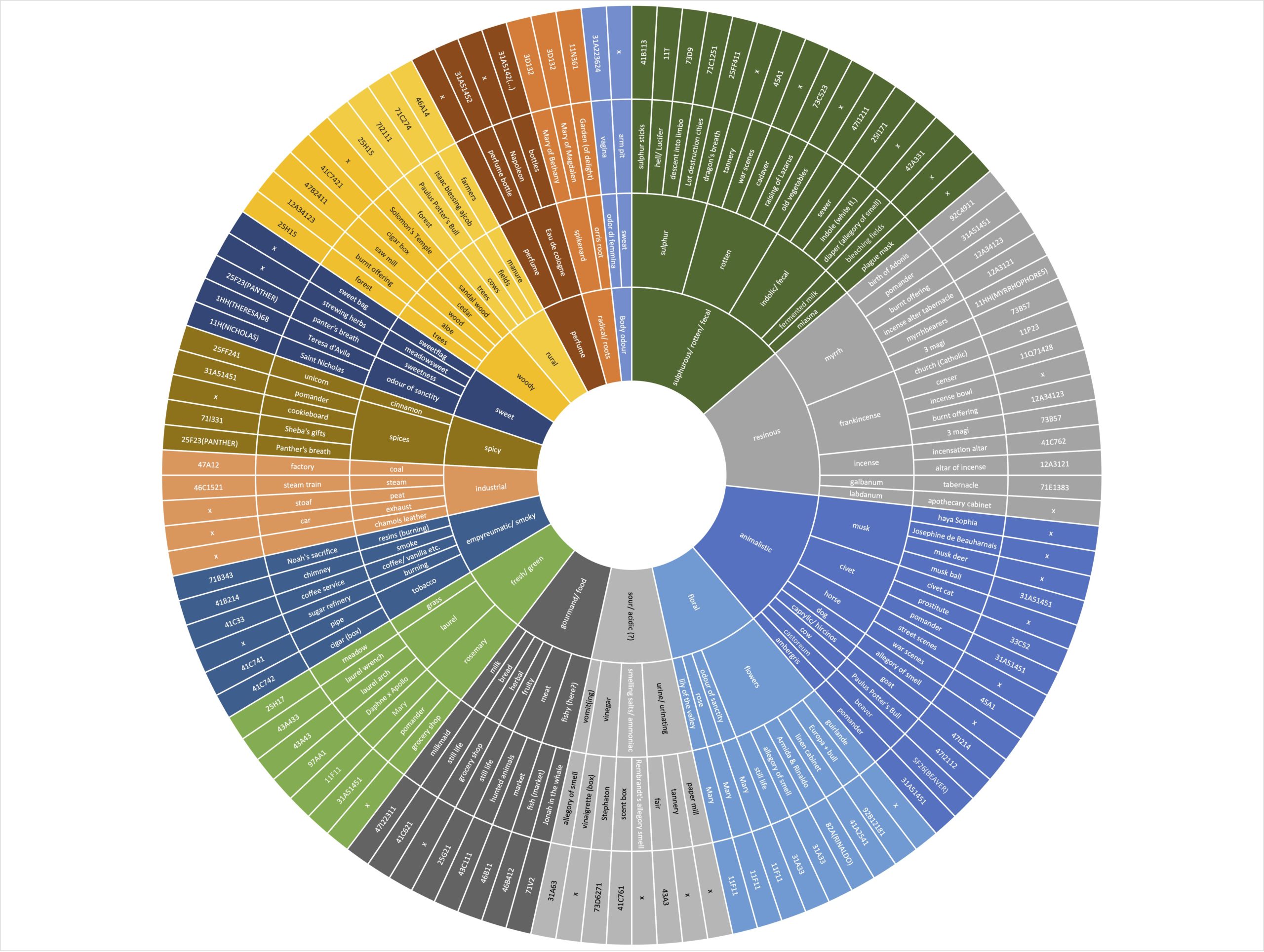
Odeuropa bundles expertise in sensory mining and olfactory heritage. We develop novel methods to collect information about smell from digital text and image collections. They will identify and trace olfactory information in text and image datasets using AI, and promote Europe’s tangible and intangible cultural heritage.

Here's one of their ongoing projects, seen in the picture above, an odor wheel based on art historical references to smells: The Odeuropa Art Historical Scent Wheel from the Mediamatic Aroma Lab.

The Odeuropa “Nose first art historical odour wheel” starting from scent families in the centre, connected to odorants in the second ring, and then to artworks and artefacts around that, ending with an outer ring with Iconclass codes. Iconclass is a multilingual online database that museums use to tag historical images and artworks. -link

This wheel is based on imagery like paintings that were then coded with words, allowing a machine-readable dataset of odors, which will become increasingly more popular as we apply this approach to larger and more recent datasets, such as the Wikimedia Commons, or the running corpus of Instagram's zero-liked images.
 
Speaking of datasets, there are many to choose, from dog breeds to aerial photographs to 3 million "Clickbait, spam, crowd-sourced headlines from 2010 to 2015," to "4,000 physical dimensions of abolone." Wikimedia commons has 7.5 million images.

Looking back at the odor wheel, there are some interesting associations here. But they do reflect the dataset. I'm having a hard time finding details on Iconoclass but it was developed by one person in the 1950's, and based I assume on Western Art. It's currently maintained by RKD Netherlands Institute for Art History.

Here's some examples -- "street scenes and horses;" not a common conjunction in today's world. "Unicorns and cinnamon," anyone? "Prostitutes and civet," less unexpected. The two "body odors" are armpit and vagina, fyi. 

The most interesting part of all this? The lead researcher Sofia Ehrich has "become familiar with detecting depictions of smell." She can smell words and pictures. 

And speaking of words and pictures: 
Ocularcentric - like a visual bias, like we as humans tend to have an ocularcentric view of the world, with our trichromatic vision and fancy visual cortices, etc. 

Notes:
Mediamatic (in Amsterdam) is an art centre dedicated to new developments in the arts since 1983. We organize lectures, workshops and art projects, focusing on nature, biotechnology and art+science in a strong international network.

IconoClass dataset -  specialized library classification designed for art and iconography.

Lifting One's Hat

Layers of IconClass system

This is an example of the layers of the IconoClass system, pretty deep stuff. You can see how the image has words attached to it, making it a machine-readable cultural object. This is how we will teach robots of the future how to better understand us, and maybe we can even teach them how to smell.

Mario Klongmann x BigGAN - 2019

Mostly Unrelated Post Script:
An AI Artist’s Twitter Feed Is an Art Gallery
The images and videos Mario Klingemann posted under the hashtag #BigGAN can only be appreciated by treating his Twitter feed as a digital exhibition. (Images taken from the ImageNet dataset)
Feb 2019, Hyperallergenic


This AI Creates Art From Instagram Posts With Zero Likes
“Zero Likes” is trained to create glitchy visuals from forgotten social media images.
May 2017, Vice

Melbourne artist and coder Sam Hains created Zero Likes, an AI trained to respond only to those lost and lonely images that miss out on attention.

Tuesday, August 10, 2021

Headline Party

My first master's degree was in architecture, and I graduated the day the United States housing market collapsed. So my second master's was in public health, and I got my first job the day Planet Earth went into pandemic lockdown. Expertise in indoor air quality and occupant exposure during an airborne pandemic will make your life pretty busy. Hence, a list of smell-related headlines I've been collecting in the meantime:

Unparalleled inventory of the human gut ecosystem
Jul 2020, phys.org
The Unified Human Gastrointestinal Genome (UHGG) collection, comprising 204,938 nonredundant genomes from 4,644 gut prokaryotes. These genomes encode >170 million protein sequences, which we collated in the Unified Human Gastrointestinal Protein (UHGP) catalog. 

via the European Bioinformatics Institute: Alexandre Almeida et al. A unified catalog of 204,938 reference genomes from the human gut microbiome, Nature Biotechnology (2020). DOI: 10.1038/s41587-020-0603-3
Fresh sea spray turns 'sour' after being airborne
Jan 2021, phys.org
"The smallest particles become 100,000 times more acidic than the ocean within two minutes," said Angle, first author of the paper.

via University of California San Diego: Kyle J. Angle et al. Acidity across the interface from the ocean surface to sea spray aerosol, Proceedings of the National Academy of Sciences (2020). DOI: 10.1073/pnas.2018397118
Researchers create a highly sensitive biohybrid olfactory sensor
Jan 2021, phys.org
So we decided to combine existing biological sensors directly with artificial systems to create highly sensitive volatile organic compound (VOC) sensors. We call these biohybrid sensors."

Takeuchi and his team essentially grafted a set of olfactory receptors from an insect into a device that feeds certain odors to the receptors and also reads how the receptors respond to these odors. 

via the University of Tokyo: T. Yamada el al. Highly sensitive VOC detectors using insect olfactory receptors reconstituted into lipid bilayers. Science Advances (2021). DOI: 10.1126/sciadv.abd2013
Male butterflies mark their mates with repulsive smell during sex to 'turn off' other suitors
Jan 2021, phys.org

Butterfly genitals secrete an odor that covers female genitals, deterring other males from mating with them. Occimene - it's the anti-aphrodisiac (for moths).

via University of Cambridge: Darragh K, Orteu A, Black D, Byers KJRP, Szczerbowski D, Warren IA, et al. (2021) A novel terpene synthase controls differences in anti-aphrodisiac pheromone production between closely related Heliconius butterflies. PLoS Biol 19(1): e3001022. 


Cosmic mouthful - Tasters savor fine wine that orbited Earth
Mar 2021, phys.org
This comes via the Institute for Wine and Vine Research in Bordeaux, and of course the International Space Station.
Researchers develop new smell test for Parkinson's, Alzheimer's and COVID-19
May 2021, phys.org
A new smell test developed by Queen Mary University of London researchers has been found to be easy to use in patients with Parkinson's disease, and could also be helpful in diagnosing COVID-19 in the broader population.

via  Queen Mary, University of London: A. Said Ismail et al. A novel capsule-based smell test fabricated via coaxial dripping, Journal of The Royal Society Interface (2021). DOI: 10.1098/rsif.2021.0039
Scientists invent an artificial nose for continuous bacterial monitoring
Jun 2021, phys.org
via Americans for Ben-Gurion University: Nitzan Shauloff et al, Sniffing Bacteria with a Carbon-Dot Artificial Nose, Nano-Micro Letters (2021). DOI: 10.1007/s40820-021-00610-w

Thursday, August 5, 2021

Diabetes x Anosmia

Interesting theme here; anosmia, insulin and Covid:

It appears that long-Covid has more to do with the pancreas and insulin regulation than we thought, and this has implications for the health of our olfactory receptors.

Research from the Monell Center found that insulin may be able to treat smell loss:
1. Insulin plays a critical role in the maturation, after injury, of immature olfactory sensory neurons (OSNs). 

2. The research team induced diabetes type 1 in mice to reduce levels of circulating insulin reaching the OSNs. The reduced insulin interfered with the regeneration of OSNs, resulting in an impaired sense of smell. 

3. In addition, the team injured OSNs, which have a unique ability to regenerate in mammals. This approach allowed the investigators to ask whether OSNs required insulin to regenerate, which they found to be true. What’s more, they discovered that OSNs are highly susceptible to insulin deprivation-induced cell death eight to 13 days after an injury. This time window indicates that during a critical stage newly generated OSNs are dependent on insulin. They also found that insulin must be applied to regenerating OSNs at this critical time point in the neurons’ growth to be able to restore a mouse’s sense of smell.

4. Insulin promotes regeneration of regenerating OSNs in both type 1 diabetic and nondiabetic mice.

Monell Center Scientists Find that Insulin is Necessary for Repairing Olfactory Neurons: Findings Point to Possible Treatment for Smell Loss, May 2021
Post Script:
July 2021, phys.org
An increase in new-onset hyperglycemia and abnormal hormone levels lasting months after Covid infection in Italy; "This study is one of the first to show that COVID-19 has a direct effect on the pancreas," says Fiorina.

via Children's Hospital Boston: Laura Montefusco et al, Acute and long-term disruption of glycometabolic control after SARS-CoV-2 infection, Nature Metabolism (2021). DOI: 10.1038/s42255-021-00407-6

Sebastiano Bruno Solerte et al, Sitagliptin Treatment at the Time of Hospitalization Was Associated With Reduced Mortality in Patients With Type 2 Diabetes and COVID-19: A Multicenter, Case-Control, Retrospective, Observational Study, Diabetes Care (2020). DOI: 10.2337/dc20-1521

Tuesday, August 3, 2021

Nanon Nanoff


Please ignore the potential environmental disaster of embedding nanoparticles all over the planet, and instead focus on how we are reverse engineering the process of chemosensation.

Plants communicate with chemicals the way we use words. Many, almost all, of the chemicals that populate the aromatic repertoire of the fragrance industry are plant-derived. If they do not come from the plant itself, as an essential oil, then they are synthetically produced in chemical reactors, yet, the target product will have originated to imitate the molecule found in nature.

Now, we get one example of synthetic biology doing the work. Imagine the scaled-up version, the chemical factory is now a biological plant, like a factory, but modeled on an actual plant, like lemongrass, but then run through bacteria programmed to produce citronellol.

Granted the nanosized sensors described in this article below are not producing any molecules, only sensing them. But any synbio fragrance plant would need a good sensor network. 

Also, "nanobionic plants" 

Carbon nanotubes embedded in leaves detect chemical signals that are produced when a plant is damaged
Apr 2020, phys.org
These sensors can be embedded in plant leaves, where they report on hydrogen peroxide signaling waves.

Plants use hydrogen peroxide to communicate within their leaves, sending out a distress signal that stimulates leaf cells to produce compounds that will help them repair damage or fend off predators such as insects. The new sensors can use these hydrogen peroxide signals to distinguish between different types of stress, as well as between different species of plants.

"Plants have a very sophisticated form of internal communication, which we can now observe for the first time. That means that in real-time, we can see a living plant's response, communicating the specific type of stress that it's experiencing," says Michael Strano, the Carbon P. Dubbs Professor of Chemical Engineering at MIT.

via Massachusetts Institute of Technology: Tedrick Thomas Salim Lew et al. Real-time detection of wound-induced H2O2 signalling waves in plants with optical nanosensors, Nature Plants (2020). DOI: 10.1038/s41477-020-0632-4
Unrelated image credit: Krzysztof Marczak via Deviant Art

Post Script:
Center for Strategic and International Studies Headquarters, Washington DC
February 6, 2020

Thursday, June 3, 2021

Artificial Olfactory Perception and the Olfactome


Chemical informatics, machine learning and the indispensable fruit-fly, Drosophila melanogaster have been used by researchers at University of California Riverside to predict odor perception. 

Olfactory prediction is kind of a holy grail of sensory perception. Sounds sus. Let's get into the data.

image credit: Diatom, by Dr. Jan Michels for Nikon Small World 2020

Using artificial intelligence to smell the roses
Aug 2020, phys.org

First sentence they're referencing Asifa Majid. That's a great start. Her work shows us that culture, language and experience influence individual odor perception. Nonetheless, the search for the human odor code continues.

After reducing a larger dataset of 84 olfactory receptors and 54 allelic variants (138 total), they took 34 receptors, each of which is controlled by a single gene, and trained machines to predict their descriptors. The descriptors, or "the words we would use to describe the smell," came from the Vosshall Keller Rockefeller University 2016 lexicon. They've got about 170 odorants, working on 34 receptors. 

Remember that each odor receptor gene can be activated by a number of chemicals, sometimes by only one, but usually by more than one. This is what makes things complicated. Olfaction is a combinatorial affair that breaks down at the granular level.

And they made a model for each receptor, 34 different models, and fed those models the odorants. They found that you could predict chemical properties of the molecules that match each receptor tested. So now, we can use the 450,000 library of chemicals, run them through each of the 36 artificial receptors, and predict what those receptors would perceive.

Figure 5A: Few Key ORs or Chemical Features Sensibly Cluster the Perceptual Descriptors
(A) Dendrogram representation of the Euclidean distances among perceptual descriptors based on overlap of perceptual response data (% Usage) from chemicals in the ATLAS study.
(B) Dendrogram from the top five ORs picked per perceptual descriptor.
(C) Dendrogram created from five randomly chosen ORs per perceptual descriptor.
(D) Dendrogram from the five best overall predictors including OR and chemical features per perceptual descriptor. Clustering is hierarchical and based on Euclidean distance (A) or the Jaccard distance (B–D). Cluster number (colored branches) inferred from gap statistic across bootstrap samples. [find the pdf for fine-resolution]

I think, and I could be wrong, but it seems the big deal here is that they made a model for each receptor, instead of just making one model for all receptors. Whereas others have created an n-dimensional predictive space to collapse the behemoth of the chemosphere into a single equation, this team just reverse-engineered the receptors themselves.

They haven't found the odor code, but they did write 34 of them. We have hundreds of olfactory receptors. That's not everything, but we are definitely getting there.

What it CAN do? It can help us discover new chemicals, and also to discover substitutes for other chemicals that are expensive, rare, or ethically-troublesome (fear-pheromones from tortured cats for example).

What it CAN'T do? It can't predict how an odor will smell to you, as an individual. It can approximate, however, and pretty good. They mention only getting 20% of the human olfactome, or human olfactory receptor repertoire.

via UC Riverside: Joel Kowalewski et al. Predicting Human Olfactory Perception from Activities of Odorant Receptors, iScience (2020). DOI: 10.1016/j.isci.2020.101361


Post Script:
They mention something called the ATLAS dataset, but I don't know what that is, other than a proprietary data analysis software. Maybe it's their own dataset through ATLAS?

And for fun, I'll report that they do mention "substantive portion of odor identity arises early in the processing stream" which is a good way of describing the the two-layer perception process of olfaction.

The second layer, and this is the one that Asifa Majid tells us is influenced by culture, experience, and language: "It is likely that the remaining portion depends on experience-dependent modulation, supporting a downstream model with reliance on distributed neuronal networks for human perceptual coding."

Further: "Unlike the retinotopic and tonotopic patterning observed in the visual and auditory cortices, representing spatiotemporal properties of visual and auditory stimuli as they are processed at sensory neurons, piriform activity appears randomly distributed, without a clear mapping of physicochemical features (Stettler and Axel, 2009)."

Interesting: "In our analyses, the OR specialized for musk was not a top candidate for
musk predictions but contributed strongly to predictions of 'sweaty.'"

Perhaps because the model isn't "smelling" it among other calculated fragrant mixtures such as perfumes, but rather "in the wild?" 


Post Post Script:
Can't talk about the odor code without mentioning code smell, a term for when something is wrong with your code, but we're not sure what it is. 

Also, going deep on the topic here:
The Dream of Olfaction Prediction